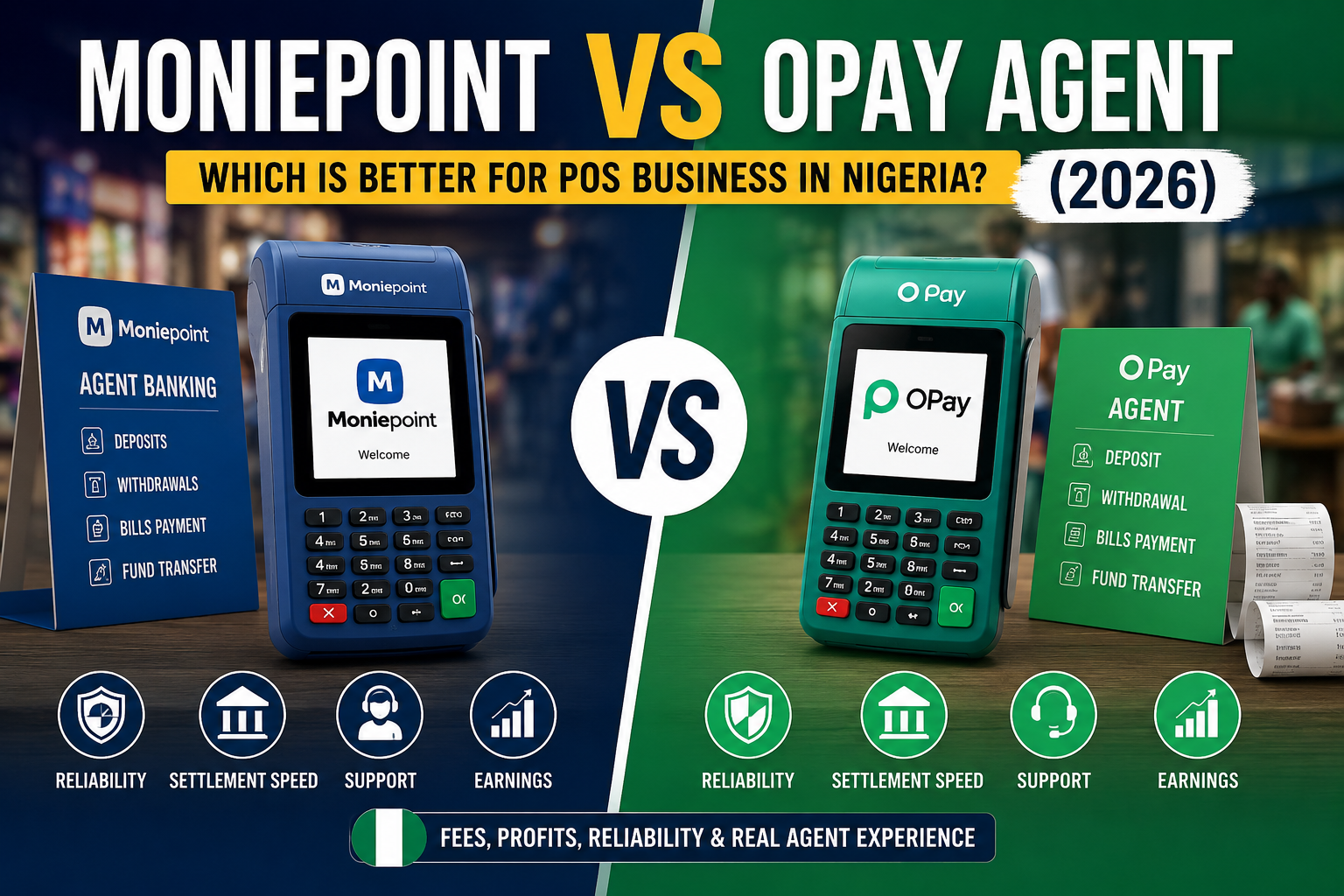
Moniepoint vs OPay Agent (2026): Which Is Better for POS Business in Nigeria?
Last Updated: June 2026
The Choice That Is Now Permanent
Until April 1, 2026, a POS agent in Nigeria could hedge their bets. A busy kiosk owner in Ojodu Berger kept a rainbow of terminals on the table – Moniepoint, OPay, PalmPay, sometimes a bank terminal – and simply reached for whichever one worked when a customer’s card arrived. If Moniepoint’s network was struggling, OPay took over. If OPay’s settlement was slow, the Moniepoint terminal filled the gap. The redundancy was deliberate and the income depended on it.
That flexibility is gone.
From April 1, 2026, POS agents in Nigeria are restricted to working with only one principal, following new guidelines issued by the Central Bank of Nigeria on October 6, 2025. The decision to become a Moniepoint agent or an OPay agent is no longer a casual, reversible preference. It is a contractual commitment with regulatory teeth — and getting it wrong has direct consequences for daily income, settlement reliability, and the long-term viability of the entire operation.
Nigeria had 8.36 million registered POS terminals, with 5.90 million active as of March 2025, processing a record ₦10.51 trillion in Q1 2025 alone — a 301.67% increase from Q1 2024. The people running those terminals are now being forced to make one of the most commercially consequential decisions of their business lives.
This is the honest, data-backed guide to making that decision well.
Quick Verdict: Moniepoint vs OPay Agent 2026
For high-volume, established POS operators: Moniepoint — deeper merchant infrastructure, stronger settlement reputation, lower per-transaction charges (0.5% up to ₦20,000; flat ₦100 above ₦20,000), and a proven track record among professional agents processing ₦500,000+ daily.
For beginners and urban operators in OPay-dense markets: OPay — easier onboarding, broader consumer familiarity, Mini POS available for ₦8,500, and strong urban brand recognition that reduces customer hesitation.
The decisive factor in 2026: The CBN’s exclusivity rule means this is a long-term choice, not a trial. Agents should evaluate settlement reliability, support quality, and commission structure as permanent operating conditions, not temporary experiments.
Brands.ng Assessment: Moniepoint has the structural edge for serious operators. OPay remains relevant in specific market conditions. Neither platform is the right choice if you have not honestly assessed your daily transaction volume, float management capacity, and target customer base first.
What You Need to Know First
- Founded: 2015 (originally TeamApt)
- CBN licence: Microfinance Bank licence (Moniepoint Microfinance Bank Limited)
- Terminal cost: ₦21,500 total (₦10,000 caution fee + ₦10,000 logistics fee + ₦1,500 insurance for 12 months). Moniepoint leases, not sells, terminals.
- Minimum daily transaction requirement: ₦80,000 daily withdrawal value, minimum 4 deposits per day
- Withdrawal charges to customers: 0.5% for ₦1–₦20,000; flat ₦100 above ₦20,000
- Transfer charges: Flat ₦20 per inter-bank transfer
- Airtime commission: 2% across all networks
- Settlement: Same-day commission settlement; T+1 default for merchant POS (same-day available for established high-volume merchants)
- 2025 transaction volume: ₦412 trillion total — equivalent to 38.5% of NIBSS’s full-year 2024 transaction value
- Market share: Claims 8 out of 10 in-person payments in Nigeria
- Founded in Nigeria: 2018
- Ownership: Opera-backed (Norwegian parent, Chinese-operated fintech)
- CBN licence: Licensed financial services operator (OPay Microfinance Bank)
- Terminal costs: Mini POS ₦8,500; Traditional POS ₦35,000; Smart POS ₦50,000
- Withdrawal charges: 0.6% below ₦20,000 (drops to 0.5% for Preferred/Level 3 merchants); flat ₦120 above ₦20,000
- Transfer charges: ₦30 for transfers below ₦10,000; ₦30 for above ₦10,000
- Airtime commissions: MTN 3%, Airtel 4%, Glo 4%, 9Mobile 4.5%
- Utility bill commission: 2% flat
- Onboarding requirement: Must be Level 3 OPay user to access POS
- Consumer base: Over 5 million active users as of last public disclosure
CBN Regulatory Context (effective April 1, 2026)
- All POS agents must now affiliate with only one principal institution — ending years of multi-platform operations that enabled agents to serve customers of Moniepoint, OPay, and PalmPay simultaneously.
- Customer daily cash-out limit: ₦100,000; weekly: ₦500,000
- Agent cumulative daily cash-out cap: ₦1.2 million
- All POS terminals must be geo-fenced to operate within 10 metres of their registered location
- Agents must route all transactions through a dedicated account or wallet provided by their principal. Using personal or non-designated accounts violates the rules and risks blacklisting.
What These Platforms Actually Are — And Why It Matters
Most POS business comparisons treat Moniepoint and OPay as two versions of the same product. They are not. They are built on different strategic foundations, which is why they serve different operators better — and why understanding the architectural difference predicts performance better than any marketing claim.
Moniepoint is a licensed microfinance bank that has built a merchant acquiring infrastructure on top of its banking licence. Because Moniepoint operates under a banking licence regulated by the CBN, it can hold merchant float, issue business accounts, extend credit, and settle funds directly into accounts it controls. This vertical integration means the entire transaction lifecycle — from card tap to settlement — happens within a single regulated entity.
This matters operationally. When a withdrawal fails at a Moniepoint terminal, the dispute, the float, and the resolution all sit within one regulated system with a single accountability chain. When a dispute escalates, there is a clear regulatory framework — the CBN’s MFB oversight — governing the resolution timeline. The agent dealing with a failed transaction at 7am on a Monday morning is dealing with one institution, not a consumer-facing app company whose primary loyalty is to its 60-million-strong user base.
OPay took the opposite architectural route. It built consumer dominance first and agent banking second. Its 2018 launch in Nigeria was aggressive — cashback campaigns, heavy app distribution, and consumer wallet acquisition at scale. The agent banking product was layered on top of an already large consumer ecosystem. This produced OPay’s most important advantage for agents: consumer familiarity. A customer who already uses OPay’s app for transfers approaches an OPay POS terminal with existing trust. The agent does not have to sell the platform — the platform pre-sold itself.
But the same consumer-scale architecture produces OPay’s most significant operational limitation for serious agents. A platform serving 60+ million consumers simultaneously is subject to transaction volume spikes that affect every product line simultaneously. When salary weekends produce high consumer transfer demand, OPay’s capacity is being consumed by consumer-side transactions at the same time that agents need settlement bandwidth. Moniepoint’s architecture — merchant-first, agent-centric, business banking focused — does not face the same simultaneous demand spike across consumer and business channels.
Moniepoint processed ₦412 trillion in 2025. Using the company’s claim that 8 out of 10 in-person payments in Nigeria go through Moniepoint, and based on NIBSS data showing Nigeria’s 2024 total electronic transaction value at ₦1.07 quadrillion, Moniepoint’s transaction volume is equal to roughly 38.5% of NIBSS’s full-year 2024 total. This is not a branding claim. It is the output of a decade of agent-first infrastructure investment.
Why Nigerian Operators Choose Each Platform
The established agent with daily volume above ₦300,000 running a busy kiosk in a market or beside a bank ATM cluster understands settlement speed as survival infrastructure. If a ₦50,000 withdrawal transaction fails at 8am and the reversal takes six hours, the day’s cash float is compromised. Moniepoint’s reputation among this operator category – built through word-of-mouth among experienced agents — is that failed transaction reversals are typically resolved same-day. That reputation, justified or not, is why the most profitable POS operators in most Nigerian markets cluster around Moniepoint terminals.
The new entrant with limited capital cannot afford Moniepoint’s ₦21,500 terminal acquisition cost and the implied float requirements without first proving the location’s transaction viability. OPay’s Mini POS at ₦8,500 offers a lower-risk entry point. The consumer familiarity advantage — customers recognizing OPay branding and trusting it before approaching the kiosk — also reduces the customer acquisition friction that makes new POS locations struggle in their first weeks.
The operator in a densely OPay-active urban area — particularly high-density residential neighborhoods in Lagos, Abuja, or Ibadan where OPay app penetration is high — benefits specifically from OPay’s consumer ecosystem. When a significant percentage of your potential customers already use OPay for peer-to-peer transfers, an OPay POS terminal slots naturally into their existing financial behavior. A Moniepoint terminal serves every card regardless of the customer’s primary app, but the conversion friction is lower with OPay in markets where consumer OPay affinity is strong.
The market trader who also needs a business account finds Moniepoint’s integrated business banking model more useful than OPay’s consumer-first architecture. Moniepoint’s business account — connected to the POS terminal — allows the operator to manage merchant settlements, business expenses, and supplier payments within one regulated account structure. OPay’s business banking features exist but are secondary to its consumer product design.
The Honest Breakdown – What the Numbers Actually Mean
Withdrawal Charges: Where Most Agent Income Is Made or Lost
The per-transaction charge comparison is the most commercially important data in this article, because it determines how much of each transaction’s income stays with the agent.
Moniepoint: 0.5% for withdrawals between ₦1 and ₦20,000; flat ₦100 for withdrawals above ₦20,000. Transfers cost a flat ₦20. Moniepoint also gives agents cashback of up to ₦20 on withdrawals and ₦5 on transfers.
OPay: 0.6% charges below ₦20,000; flat ₦120 above ₦20,000. The rate drops to 0.5% for Preferred Merchant (Level 3) status. Transfers are ₦30 for most transaction ranges.
On a ₦10,000 withdrawal:
- Moniepoint charges the customer ₦50 (0.5%)
- OPay (standard) charges ₦60 (0.6%)
- OPay (Preferred Merchant) charges ₦50 — same as Moniepoint
On a ₦30,000 withdrawal:
- Moniepoint charges the customer a flat ₦100
- OPay charges a flat ₦120
The difference per transaction is small. The difference across 100 daily transactions compounds meaningfully over a month. An agent processing 100 withdrawals averaging ₦15,000 each daily earns approximately ₦20 more per transaction on Moniepoint’s standard rate compared to OPay standard — that is ₦2,000 per day, ₦60,000 per month before other commission variables. For agents already on OPay’s Preferred Merchant rate, this difference narrows significantly.
Settlement Speed: The Variable That Determines Daily Cash Flow
For merchants who have built enough transaction history and maintain consistent volumes, same-day settlement becomes available on Moniepoint — but this is not the default and not guaranteed from day one. The default settlement cycle is T+1 (next business day).
Moniepoint’s daily commission settlement — paying agents their earned commissions same-day — was a breakthrough feature when introduced, because agents need daily liquidity to restock their float and manage household cash flow. For most established Moniepoint agents, commission settlement arrives same-day. For float settlement on the underlying transactions, T+1 is the baseline with same-day available for proven volume merchants.
OPay’s settlement structure provides instant settlement for some transaction types within its wallet ecosystem, but inter-bank settlement timelines follow standard NIBSS processing cycles. During peak periods — month-end salary weekends, national public holidays, major commercial events — both platforms experience settlement delays that are system-level rather than platform-specific.
Terminal Reliability: Uptime Is Revenue
No publicly verified uptime statistics are published by either Moniepoint or OPay, so any comparison here is based on observable user sentiment patterns rather than audited data.
The pattern that emerges consistently across Nairaland, Google Play reviews, and X (Twitter) discussions is: experienced high-volume POS operators rate Moniepoint terminal reliability higher than OPay, particularly during peak network congestion periods. The structural reason cited most frequently is Moniepoint’s agent-centric infrastructure investment — because agent banking is Moniepoint’s primary product, not a secondary offering built on top of a consumer app.
Also read: OPay POS Machine: How to Get One, Charges & What Agents Earn
OPay terminals receive better reviews on ease of setup and initial reliability. Complaints about OPay terminal performance concentrate specifically during high-volume national events where consumer demand peaks simultaneously with agent demand, straining shared infrastructure.
What Neither Platform Tells You Before You Sign Up
The CBN exclusivity rule fundamentally changes the risk calculus of your choice.
Before April 2026, a bad Moniepoint experience could be hedged with an OPay terminal in reserve. Under the new rules, that flexibility is no longer available. Each agent must select a single partner institution, operate from a designated location, and adhere to stricter transaction limits and reporting requirements. A poor platform choice now requires terminating the existing contract before switching — and switching from one principal or super agent to another will only be permissible at the expiration of an existing contract.
The ₦1.2 million daily agent cash-out cap will constrain high-volume operators.
The CBN’s new rules cap agent cumulative daily cash-out at ₦1.2 million across all transactions. For a busy kiosk in a commercial market — where ₦1.2 million in daily withdrawals is achievable before noon — this cap represents a hard ceiling on daily income. Operators in high-traffic locations need to factor this ceiling into their income projections before choosing a platform, because neither Moniepoint nor OPay can exceed the CBN-imposed limit regardless of terminal capability.
The geo-fencing rule eliminates mobile and roving POS operations.
Under the new guidelines, the CBN requires every POS terminal to be registered to a specific physical location — typically a kiosk or retail shop — and the device will only function within a ten-metre radius of that registered point. Agents who previously ran mobile POS operations — at markets, events, or moving between locations — must either formalize a fixed location or exit the formal agent banking system. This requirement applies equally to Moniepoint and OPay agents, but it changes the economics for operators who relied on mobility for volume.
Moniepoint’s daily minimum transaction requirement is a performance obligation, not a suggestion.
Moniepoint requires agents to process at least ₦80,000 in daily withdrawal value and complete at least four deposits per day. Agents who consistently fail to meet these targets risk having their terminal reassigned. New agents who deploy a Moniepoint terminal in a low-traffic location may find the terminal retrieved before the business has had time to establish a customer base. OPay does not publish equivalent minimum daily volume requirements for standard agents.
OPay’s account restriction pattern is the most documented complaint in the public record.
A pattern observable across OPay’s Google Play Store reviews, Trustpilot entries, and Nairaland threads shows account restrictions — temporary freezes triggered by compliance monitoring — as the most consistently cited negative experience. These restrictions are not arbitrary. They follow CBN’s anti-money laundering and KYC compliance requirements that all regulated fintechs must enforce. But the pattern suggests OPay’s compliance system generates more frequent agent-facing restrictions relative to its agent base than Moniepoint does. The structural reason: OPay’s compliance monitoring was built primarily for its consumer base, where transaction patterns are more variable and fraud exposure is higher. Agent banking transactions, which OPay added to a consumer-first system, run through the same compliance infrastructure.
Moniepoint’s terminal lease model means you never own your equipment.
Moniepoint leases, not sells, POS terminals. Even after paying the ₦21,500 setup fee, Moniepoint retains ownership and can reassign the terminal if minimum volume requirements are not met. If the terminal is returned in excellent condition, Moniepoint refunds ₦10,000. This lease structure reduces upfront risk but means the agent’s primary income-generating asset remains Moniepoint’s property throughout the relationship. Understanding this before signing is more important now that the relationship is exclusive.
User Sentiment Analysis
What Moniepoint agents consistently praise: Terminal reliability during peak periods is the most frequent positive across public reviews and agent community discussions. Settlement consistency — specifically same-day commission payout — is described by established agents as the feature that most directly supports their daily operations. The agent support infrastructure, including field cluster managers who visit agents, receives specific positive mention from operators in smaller markets where remote support is insufficient.
What OPay agents consistently praise: Consumer brand familiarity reducing customer acquisition friction in urban markets. Ease and speed of initial onboarding compared to Moniepoint’s more documentation-intensive process. The lower terminal acquisition cost — particularly the ₦8,500 Mini POS — enabling new entrants to test a location before committing significant capital.
When problems most often occur on both platforms: End-of-month salary periods generate the highest transaction volume in the Nigerian POS market and produce the highest concentration of failure events. The average commission for an agent transaction is approximately 0.3%, capped at ₦18–₦20. During peak salary periods, the volume required to generate meaningful income is highest, and the infrastructure pressure on both platforms is simultaneously at its peak — creating conditions where both settlement delays and terminal connectivity problems are most likely. Planning cash float specifically for these periods is more important than platform choice for managing end-of-month income volatility.
Sentiment trend: The introduction of the CBN exclusivity rule has shifted agent community sentiment from comparative (“which terminal should I add?”) to evaluative (“which one should I keep?”). This shift is producing more detailed, deliberate assessments of each platform’s specific strengths from agents who previously ran both and can now compare from direct experience. The early post-exclusivity-rule pattern in Nairaland and POS agent WhatsApp community discussions suggests experienced operators are choosing Moniepoint in majority, while newer agents are more evenly distributed.
Legitimacy and Safety
Are both platforms legitimate? Yes. Moniepoint Microfinance Bank Limited holds a CBN microfinance banking licence. OPay operates as OPay Microfinance Bank, also CBN-licensed. Both are regulated entities subject to CBN oversight, NDIC insurance frameworks, and the full compliance requirements of their respective licence types. Neither platform is a fraudulent operation or an unregulated wallet service.
What “safe” means in agency banking: Safety in the POS agent context means primarily: regulatory compliance of the principal, settlement reliability, and dispute resolution access. Both platforms provide the first. The second differentiates between them in observable ways. The third varies by case complexity — simple failed-transaction reversals are generally resolved within the stated timeframe by both platforms; complex disputes involving large amounts or compliance-triggered restrictions take longer and benefit from documentation at every stage.
What most new agents misunderstand about risk: The primary operational risk in POS business is not platform fraud. It is liquidity mismanagement — specifically, running out of float during peak demand periods because settlement timing does not align with customer demand timing. An agent who exhausts float at 10am on salary Monday and waits until 3pm for a T+1 settlement credit is not a victim of platform failure. They are a victim of insufficient float management. Neither Moniepoint nor OPay can solve this problem for an agent who does not have the capital buffer to bridge settlement gaps.
Frequently Asked Questions – Answered in Depth
Which Is Better, Moniepoint or OPay?
For most professional POS operators in Nigeria in 2026, Moniepoint is the stronger platform. The structural reasons are specific: lower per-transaction charges (0.5% vs OPay’s 0.6% standard rate), a merchant-first infrastructure that prioritizes agent settlement over consumer transaction volume during peak periods, and a stronger documented track record among high-volume operators for terminal reliability and same-day commission payout.
OPay is better in specific conditions: for new entrants who want lower terminal acquisition costs (Mini POS at ₦8,500 vs Moniepoint’s ₦21,500), for operators in urban markets with dense existing OPay consumer penetration, and for agents who want faster initial onboarding without Moniepoint’s minimum daily transaction requirements.
The CBN’s April 2026 exclusivity rule makes this a permanent choice rather than a preference that can be reversed. Evaluate both platforms against your specific location’s daily transaction volume, your available float capital, and your target customer base before committing — because switching after April 2026 requires contract expiration, not just a decision.
What Are the Benefits of Being an OPay Agent?
Being an OPay agent in 2026 offers six specific benefits that are commercially relevant:
Lower terminal acquisition cost. OPay’s Mini POS costs ₦8,500 — the most accessible entry point among major POS providers and significantly below Moniepoint’s ₦21,500 setup fee. This matters for new entrants testing a location before committing significant capital.
No minimum daily transaction requirement. Unlike Moniepoint’s ₦80,000 daily minimum, OPay does not publish a mandatory minimum daily volume for standard agents. This gives new agents more time to build transaction volume before facing terminal retrieval risk.
Strong consumer brand familiarity. OPay’s aggressive consumer marketing has produced strong brand recognition in urban Nigerian markets. Customers who already use OPay for transfers approach an OPay POS terminal with pre-existing trust, reducing customer acquisition friction for the agent.
Commission structure on airtime and utilities. OPay agents earn: MTN airtime 3%, Airtel 4%, Glo 4%, 9Mobile 4.5%, and 2% on utility bill payments. Agents in residential areas with high electricity and subscription bill payment demand benefit specifically from the utility commission structure.
Faster initial onboarding. OPay’s agent onboarding process — upgrading to Level 3 via the app and submitting documents — is generally completed within 24–72 hours. Moniepoint’s field agent process, which involves cluster manager contact and physical terminal delivery, takes longer.
Preferred Merchant rate access. Agents who achieve and maintain Level 3/Preferred Merchant status access the 0.5% withdrawal charge rate — equivalent to Moniepoint’s standard rate — plus access to lower charges on other transaction types.
How Can I Be a Moniepoint Agent?
Becoming a Moniepoint agent in 2026 involves a specific process that reflects Moniepoint’s more rigorous onboarding standard:
Step 1 — Create a Moniepoint Business Account. Visit moniepoint.com and register with your full name, email, phone number, and BVN. Complete KYC verification including face and ID verification. Set your business name, username, and PIN.
Step 2 — Verify eligibility requirements. You must be: Nigerian, 18+, in possession of a valid government-issued photo ID (passport, NIN slip, voter’s card, or driver’s licence), a recent utility bill (electricity, water, tenancy agreement, or waste bill), and a smartphone capable of running the Moniepoint app. CAC documents are required for registered businesses.
Step 3 — Request a POS terminal. Log into your Moniepoint Business Account, navigate to POS under the Channels menu, and select the MP35P Smart POS terminal. The total cost is ₦21,500, which includes: ₦10,000 caution fee, ₦10,000 logistics fee, and ₦1,500 insurance fee valid for 12 months.
Step 4 — Fund your account. A minimum float in your Moniepoint account is required before the terminal is activated. Moniepoint expects agents to maintain sufficient float for daily operations — the minimum daily withdrawal target of ₦80,000 requires float capacity to support this volume without mid-day depletion.
Step 5 — Cluster manager contact. A Moniepoint cluster manager will contact you within 48 hours of your application to guide the next steps, verify your location, and facilitate terminal delivery.
Ongoing obligations: Your terminal must process at least ₦80,000 in daily withdrawal value. If it does not meet this target consistently, Moniepoint may reassign the terminal. If you return the POS in excellent condition, Moniepoint refunds ₦10,000 of your caution fee.
What Are the Disadvantages of OPay?
OPay has five specific disadvantages that are commercially relevant for POS agents evaluating the platform:
Higher standard withdrawal charge. OPay’s standard withdrawal charge is 0.6% — higher than Moniepoint’s 0.5% on the same transaction value below ₦20,000. For an agent processing ₦500,000 in daily withdrawals across multiple transactions, this 0.1% difference compounds to a meaningful income gap. The 0.5% rate is only available after achieving Level 3/Preferred Merchant status, which requires additional documentation and approval.
Account restriction pattern. The most consistently documented negative experience among OPay agents is compliance-triggered account restrictions — temporary freezes that suspend transaction access pending verification. These are not OPay-specific malpractice; they are CBN compliance requirements applied through OPay’s monitoring system. But the frequency of restrictions in the public complaint record is higher for OPay than for Moniepoint, suggesting OPay’s compliance system generates more false-positive triggers in the agent banking context.
Consumer-first infrastructure priority. OPay’s settlement and capacity infrastructure was designed around its 60-million-strong consumer user base. During peak periods when consumer transaction demand is highest, agent banking settlement competes with consumer wallet processing for the same infrastructure capacity. Moniepoint’s agent-first architecture does not face the same internal competition between consumer and agent demand.
Chinese ownership creates periodic regulatory scrutiny. OPay is backed by Opera, a Norwegian-listed company with Chinese controlling ownership. This ownership structure has periodically attracted CBN scrutiny and public commentary in Nigeria, and creates a layer of reputational and regulatory uncertainty that Moniepoint — a founder-led Nigerian fintech — does not share.
Terminal cost for full-featured devices. While OPay’s Mini POS is cheaper than Moniepoint’s terminal, OPay’s Smart POS costs ₦50,000 — more than double Moniepoint’s ₦21,500 for a comparable full-featured device. Agents who need the Smart POS capabilities pay a significant premium over Moniepoint’s equivalent.
Competitor Comparison
| Feature | Moniepoint | OPay | PalmPay | Kuda/FirstBank Agent |
|---|---|---|---|---|
| CBN licence type | Microfinance Bank | Microfinance Bank | Microfinance Bank | MFB / Commercial Bank |
| Terminal cost (entry) | ₦21,500 (MP35P) | ₦8,500 (Mini POS) | ₦15,000 (approx.) | Varies by bank |
| Withdrawal charge (<₦20k) | 0.5% | 0.6% (0.5% Preferred) | 0.5% | Varies |
| Withdrawal charge (>₦20k) | ₦100 flat | ₦120 flat | ₦100 flat | Varies |
| Transfer charge | ₦20 flat | ₦30 | ₦10–₦20 | Varies |
| Daily minimum volume req. | ₦80,000 | Not published | Not published | Varies |
| Settlement model | Same-day commission; T+1 float | Instant (intra-OPay); NIBSS for inter-bank | Variable | Bank-standard |
| Consumer brand familiarity | High (agent-centric) | Very high (consumer-centric) | High | Moderate |
| Agent support model | Field cluster managers | App/email/phone | App/phone | Branch-based |
| Business banking integration | Full MFB product suite | Limited | Limited | Full bank suite |
| Best for | High-volume professional agents | Beginners + urban OPay markets | Cost-conscious operators | Bank-affiliated businesses |
Who Should Use Moniepoint — and Who Should Use OPay
Choose Moniepoint if you:
- Already process or plan to process ₦300,000+ daily in withdrawals and can demonstrate consistent volume
- Operate in a commercial market, beside a bank ATM cluster, or in a high-footfall location with established customer traffic
- Need same-day commission payout to manage daily household and float cash flow
- Want integrated business banking — savings, transfers, and merchant settlement within one MFB account
- Are an experienced operator who has previously run POS and understands float management, dispute documentation, and terminal reliability requirements
Choose OPay if you:
- Are new to POS business and want to test a location with the lowest possible capital commitment (₦8,500 Mini POS)
- Operate in a dense urban area where OPay consumer app penetration is visibly high among your target customer base
- Cannot guarantee ₦80,000 daily withdrawal volume consistently enough to meet Moniepoint’s minimum requirements
- Want the fastest possible onboarding with minimal field agent interaction
Avoid committing to either platform if you:
- Have not verified that your proposed location generates sufficient daily foot traffic for POS viability
- Do not have capital to maintain adequate float through T+1 settlement cycles
- Are not prepared for compliance-related identity verification, which both platforms enforce under CBN KYC requirements
- Are expecting passive income — POS business is operationally demanding, and platform choice is a secondary variable behind location, float management, and customer service quality
Realistic Expectations for POS Operators in 2026
What successful operations look like: On good days, a productive POS agent can earn between ₦90,000 and ₦360,000 monthly — with the wide range reflecting the critical importance of location and transaction volume rather than platform choice. Consistent daily volume above ₦500,000 in withdrawals, combined with transfers and utility commissions, produces stable income. The CBN’s ₦1.2 million daily agent cap means the upper income ceiling is now regulated rather than just market-constrained.
What goes wrong and when: Failed reversals during network congestion peak periods generate the most acute daily stress for POS operators. End-of-month salary weekends, public holiday clusters, and post-CBN-system-update periods concentrate the highest failure rates. Agents currently operating with thin margins who relied on multiple terminals to manage risk will find the CBN exclusivity rule potentially disruptive — their income may decline if they chose a platform that underperforms on their specific route type.
What most new agents underestimate: Float management is harder than it appears from the outside. A successful busy kiosk may process ₦1 million in withdrawals on a salary weekend morning — which means the agent needs ₦1 million in accessible float before that morning starts, because settlement from those transactions arrives T+1. New agents who deploy without sufficient float capital discover the limitation at the worst possible moment: when customer demand is highest.
Moniepoint vs OPay: The Brands.Ng Verdict
The CBN’s exclusivity rule has converted what was once a tactical preference into a strategic commitment. That changes the standard of scrutiny any POS operator should apply to this decision.
Moniepoint is the stronger platform for the operator who approaches POS business as a serious, full-time operation — not because its branding is better or its app is more attractive, but because its entire infrastructure was built to serve the agent first. The terminal reliability, the same-day commission settlement, the cluster manager field support, and the lower standard withdrawal charge are not marketing features. They are the output of a decade of merchant-first product development. Moniepoint processing ₦412 trillion in 2025 — equivalent to 38.5% of NIBSS’s full-year 2024 total — is what merchant-first infrastructure at scale actually produces.
Also read: Failed Bank Transfers in Nigeria: How to Force a Reversal Instantly (GTB, Zenith, Opay, Palmpay)
OPay is the right starting point for the new entrant who needs the lowest possible barrier to entry, or the urban operator in a market where OPay consumer penetration genuinely reduces customer acquisition friction. It is not the right long-term platform for an operator who will build significant daily volume, because the per-transaction economics are less favorable at standard rates, and the compliance restriction pattern creates operational disruption that is particularly costly at high volume.
The most important thing either platform can tell you is what they cannot tell you: that your POS business will succeed. Location, float discipline, and customer relationship management determine POS business viability far more than terminal brand. The platform choice determines how much friction you experience in the process of building that business — and how much income remains after charges, once it is running.
Under the CBN’s new exclusivity rules, choose deliberately. You will be living with the decision.
Editorial Note: This review reflects publicly available information, verified regulatory data, and operator-reported experiences as of June 2026. Brands.ng does not receive payment for editorial coverage. Both Moniepoint and OPay were given the opportunity to respond to findings prior to publication. No response was received from either company at time of publishing. POS business involves financial risk. Operators should conduct independent due diligence on float requirements, location viability, and platform terms before committing under the CBN’s April 2026 exclusivity framework.


Augustine Tom is the founder and publisher of Brands.Ng, an African business intelligence and digital economy platform covering fintech, ecommerce, logistics, startups, digital platforms, and consumer trust across Africa. He writes about branding, business growth, digital strategy, innovation, and emerging market trends, drawing from experience in business development, consulting, SEO, and digital marketing across diverse industries. His work focuses on analyzing the technologies, systems, and companies shaping Africa’s evolving digital economy.