
Last Updated: June 2026 Reviewed by: Brands.Ng Editorial Team
Eight out of every ten in-person payments made in Nigeria today pass through a Moniepoint terminal. Not seven. Not six. Eight. That single statistic, published by Moniepoint itself in its 2025 annual review and consistent with CBN data showing the platform processed ₦412 trillion across more than 14 billion transactions last year, explains why Moniepoint is not simply a fintech app. It is, by any reasonable measure, the physical payment infrastructure of the Nigerian economy.
The Suya seller in Wuse Market who accepts transfers. The fabric trader in Ariaria who runs cash withdrawals for customers. The pharmacy in Surulere with a terminal on the counter. The kiosk operator in Owerri whose entire livelihood runs through a single device. In each of these settings, the machine is almost certainly Moniepoint.
But infrastructure status creates specific expectations, and specific frustrations when those expectations are not met. This review addresses what Nigerians are actually asking about Moniepoint in 2026: whether it qualifies as a good bank, how its weekly target system works and what happens when agents miss it, which platform genuinely wins the Moniepoint versus OPay comparison, whether it is properly regulated, what the app actually does, and whether it is truly legit.
Legitimacy: Fully legitimate – Moniepoint Microfinance Bank was licensed by the Central Bank of Nigeria as a microfinance bank and received a national MFB licence upgrade in 2025.
Safety: Safe for business and personal transactions. CBN-regulated, NDIC-insured, BVN and NIN verified. Primary risk is customer support delays during complex disputes, not platform fraud.
Best for: POS agents processing daily cash transactions; small and medium business owners needing reliable payment infrastructure and business loans; merchants who want their payments, banking, and business management in one platform; individuals who want a reliable personal bank account without minimum balance requirements.
Biggest risk: Moniepoint enters 2026 facing tighter CBN regulation, broader product reach, and rising credit risk. For agents, the April 2026 single-principal rule means the decision to choose Moniepoint is now more consequential than before. For borrowers, loan product terms warrant careful scrutiny.
Brands.Ng Assessment: Nigeria’s dominant POS and business banking platform, built for the informal economy that commercial banks have never adequately served, with a personal banking layer that is newer but growing rapidly.
What You Need to Know First
- Founded: 2015 as TeamApt; rebranded as Moniepoint in 2022
- Founders: Tosin Eniolorunda (CEO) and Felix Ike (CTO)
- Headquarters: Lagos, Nigeria – with support offices across 33 states
- Legal entity: Moniepoint Microfinance Bank
- CBN licence: National Microfinance Bank licence – upgraded to national status in 2025
- CBN licence upgrade: January 2026 – confirmed alongside OPay, PalmPay, Kuda, and Paga
- NDIC insurance: Yes – deposits insured up to ₦5 million
- 2025 transaction volume: Over 14 billion transactions worth ₦412 trillion in 2025
- Market share: POS transactions between January and June 2025 totalled ₦147.19 trillion – Moniepoint controls approximately half of Nigeria’s POS economy
- Business customers: Over 2 million businesses
- Personal banking users: 30+ million people use Moniepoint POS terminals monthly
- Total funding: $256 million across 6 rounds – most recently a $90 million Series C in October 2025
- Series C investors: Development Partners International, Google’s Africa Investment Fund, Visa, the International Finance Corporation, and Verod Capital
- Valuation: $1 billion – unicorn status confirmed in 2025
- Revenue: $600 million ARR in 2025, up from $264 million in 2023
- Employees: Approximately 5,230 employees as of 2026
- Apps: Moniepoint Business Banking App + Moniepoint Personal Banking App – both available on Google Play and App Store
- Stamp duty (2026): ₦50 on all transfers of ₦10,000 and above – applies across all Nigerian financial institutions under the Nigeria Tax Act 2025
- CBN geo-fencing deadline: August 1, 2026 – Moniepoint and all POS operators must geo-tag terminals to GPS coordinates under CBN’s updated circular of May 29, 2026
The single biggest misunderstanding about Moniepoint in Nigerian public discourse is that it is a POS company. It is not. It began as one. It is now something considerably more complex, and understanding that complexity is essential for anyone making a decision about using it.
Moniepoint operates three interconnected business layers that reinforce each other with unusual structural strength.
The first layer is the POS and agent banking network, which is the physical distribution infrastructure that made Moniepoint’s name. Over a decade, Moniepoint built what is now Nigeria’s largest on-the-ground financial services distribution network. Terminals in markets, kiosks, pharmacies, and informal shops process withdrawals, deposits, and transfers for customers who either cannot or choose not to use commercial bank branches. This network processes the bulk of Moniepoint’s transaction volume and generates the commission income that sustains the agent ecosystem.
The second layer is business banking – the product set aimed at the business owners who anchor the agent network and the millions of Nigerian SMEs that need payment infrastructure, working capital, and financial management tools. Business accounts, expense cards, savings plans, POS terminals, and business loans are all part of this layer. More than 2 million business customers trust Moniepoint with their business bank account.
The third layer – newer and still scaling – is personal banking. Through the personal banking app, users can make transfers, pay bills, and buy airtime, with a card dispute resolution system that gives users control over failed card transactions for the first time. Personal banking completes Moniepoint’s ambition to serve the full financial life of the Nigerian SME ecosystem – the business owner, their employees, and their customers.
How Moniepoint makes money is through multiple simultaneous revenue streams. POS transaction fees and withdrawal commissions generate income at the agent network layer. Business account fees, card services, and payment processing fees generate income at the business banking layer. Moniepoint disbursed over ₦1 trillion in loans in 2025 – and at annual interest rates of at least 20% on performing loan balances, credit income has become a significant and growing revenue component. Bill payment commissions, airtime margins, and savings product float round out the picture.
The strategic logic behind this architecture is described by TechCabal’s analysis: between 2019 and 2025, Moniepoint moved from being a merchant acquiring company with strong distribution to becoming something closer to national infrastructure, with payments as the hook and credit as the margin engine.
The POS agent building a community mini-bank In Nigerian towns and neighborhoods, a Moniepoint agent with a functioning terminal is the practical equivalent of a bank branch for residents who need cash. The agent earns commissions on every withdrawal, deposit, and transfer processed. For operators who meet their daily and weekly targets consistently, the income is predictable and scalable. Moniepoint’s daily commission settlement – the practice of paying agents their earned commissions same-day – was a breakthrough feature when the company launched it, because agents needed daily liquidity to restock and manage their own households.
The market trader managing daily cash flow without a bank account A spare parts dealer in Aba or a fabric seller in Onitsha who receives dozens of customer payments daily does not need a formal bank account with minimum balance requirements and monthly charges. Moniepoint’s business account, accessible from a phone, provides a dedicated account number for receiving transfers, a POS terminal for card payments, and a dashboard for tracking what came in and went out. The infrastructure cost is a fraction of traditional banking.
The SME owner who needs working capital without collateral Moniepoint’s business loans – disbursed based on transaction history and platform data rather than traditional collateral requirements – fill a gap that Nigerian commercial banks have failed to address for decades. An entrepreneur whose transaction history on Moniepoint demonstrates consistent business volume becomes eligible for credit at terms calibrated to actual business performance. This data-driven lending model is why Moniepoint disbursed over ₦1 trillion in loans in 2025.
The retail business owner who wants payments and bookkeeping in one place In August 2025, Moniepoint launched Moniebook, its business management platform, positioning itself not only as a payments provider but as a business management partner. For a small retailer who previously managed payments on one app, accounting on paper, and bank reconciliation manually, Moniebook consolidates these functions. Businesses like Shafa Energy and Fruitylife have already moved onto the platform.
The diaspora Nigerian sending money home In April 2025, Moniepoint launched Monieworld, a remittance product allowing UK residents to send money directly to any Nigerian bank account, growing primarily through word of mouth within UK Nigerian communities. For Nigerians in the UK, this adds a credible remittance option backed by the same infrastructure their families and businesses already use on the ground.
POS Terminal and Agent Banking
What it does: Processes cash withdrawals, deposits, transfers, and card payments through physical terminals deployed at agent locations nationwide.
What it means in practice: Moniepoint processed ₦8 billion daily for restaurants, ₦1.7 trillion at bakeries, and ₦90 million at gyms daily in 2025. These numbers illustrate that Moniepoint’s terminal network is embedded in the operational cash flow of Nigerian businesses at every scale from street food to established retail. For an agent, the terminal is the revenue engine. For a business owner, it is the payment acceptance infrastructure. Reliability – meaning transactions that complete without errors – is the metric that matters most to both, and Moniepoint’s track record on this dimension is why agents consistently cite it as their preferred provider.
What to watch out for: From April 1, 2026, all POS agents must now be exclusive to one principal financial institution under CBN’s new agent banking rules. This means the decision to operate as a Moniepoint agent is now permanent for the duration of the relationship – switching costs have increased significantly. Agents should evaluate Moniepoint’s commission structure, support quality, and terminal reliability with this exclusivity requirement in mind before committing.
Business Banking Account
What it does: Provides a dedicated business bank account with a unique account number, transaction tracking, expense cards for staff, savings plans, and payment collection tools.
What it means in practice: Moniepoint Business Bank provides businesses with mobile banking solutions that enable them to create their own business bank account, accept online and offline payments, purchase airtime, pay utility bills, transfer money, request expense cards, and qualify for business loans. For a Nigerian SME previously managing finances through a personal bank account – with all the reconciliation confusion that creates – a dedicated business account with integrated POS data is a genuine operational upgrade.
What to watch out for: Moniepoint’s business banking is optimised for SMEs, not large corporations. Businesses requiring advanced treasury management, multi-currency accounts, sophisticated trade finance, or formal corporate banking structures will find the product set insufficient. For those needs, a commercial bank relationship remains necessary.
Business Loans
What it does: Provides working capital loans to business customers based on transaction history and platform data, without traditional collateral requirements.
What it means in practice: Access to credit based on demonstrable transaction history rather than property collateral removes the primary barrier that has historically excluded informal Nigerian businesses from formal lending. An agent or merchant who has processed consistent volumes through Moniepoint for six months or more builds a credit profile that the platform can lend against.
What to watch out for: Loan terms, interest rates, and repayment conditions should be reviewed carefully before acceptance. Moniepoint enters 2026 facing rising credit risk as its loan book has expanded aggressively. The platform’s NPL management and credit collection practices are areas to monitor. Borrowers should understand the full annualised cost of any loan before committing.
Personal Banking App
What it does: A separate consumer-facing app providing personal bank accounts, money transfers, bill payments, airtime purchases, savings features, and a debit card with in-app dispute resolution.
What it means in practice: The personal banking app extends Moniepoint’s reach beyond business owners to the employees, customers, and family members of its SME ecosystem. The card dispute resolution system gives every user the ability to log disputes for failed card transactions and track them until full reversal – giving users control over dispute resolution for the first time. For someone whose previous experience of card disputes involved calling a bank’s helpline and waiting indefinitely, this is a meaningful improvement.
What to watch out for: The personal banking app is newer than the business banking product and still scaling. Transaction history accessibility – a recurring complaint in App Store reviews where users report difficulty retrieving older transaction records – is an area that needs improvement. Users who need long-term transaction records for business or legal purposes should maintain supplementary records independently.
MonieWorld – UK to Nigeria Remittance
What it does: Allows UK-based Nigerians to send money directly to any Nigerian bank account.
What it means in practice: A diaspora product backed by Moniepoint’s domestic infrastructure removes the intermediary risk associated with informal remittance channels and provides settlement directly into Nigerian bank accounts rather than requiring recipient wallet registration.
What to watch out for: Monieworld is a newer product and exchange rates, transfer fees, and operational reliability are still being established. Compare rates against established remittance services before committing to Monieworld as a primary channel.
What Moniepoint Does Not Tell You
The CBN’s tightening regulatory grip is the biggest business risk for agents in 2026
Most Moniepoint reviews focus on fees and reliability. The most consequential development for agents in 2026 is regulatory. From April 1, 2026, Nigeria’s two million banking agents must choose between Moniepoint, OPay, and PalmPay – with the new CBN guidelines requiring agents to be exclusive to one principal, ending years of multi-platform operations.
This exclusivity requirement fundamentally changes the risk calculation for agents. Previously, an agent who experienced Moniepoint downtime or a dispute could switch to their OPay terminal while the issue was resolved. That flexibility is gone. An agent who commits to Moniepoint exclusively and then experiences a service disruption, a terminal fault, or a prolonged dispute has no immediate fallback. The decision to choose Moniepoint under the new framework is a business partnership decision, not just a technology preference.
Additionally, under the CBN’s geo-fencing framework with a compliance deadline of August 1, 2026, Moniepoint and all POS operators must geo-tag every terminal and link them to precise GPS coordinates – meaning terminals cannot be operated outside their registered location. Agents who move their terminals between locations regularly need to understand this requirement and its compliance implications before the deadline.
Moniepoint’s dominance creates its own risk
POS transactions between January and June 2025 totalled ₦147.19 trillion – Moniepoint controls approximately half of Nigeria’s POS economy. Infrastructure at this scale creates systemic risk that does not exist for smaller platforms. When Moniepoint experiences downtime – however briefly – the impact cascades across hundreds of thousands of agents simultaneously. Several such incidents have occurred, typically during high-volume periods or system updates, and user sentiment data shows these events generate disproportionate frustration precisely because the platform’s reliability is so deeply relied upon.
The loan product requires careful reading
Moniepoint’s working capital loans are genuinely valuable for SMEs who cannot access traditional bank credit. But the rapid growth of the loan book – over ₦1 trillion disbursed in 2025 – reflects aggressive credit expansion that carries risk for both the platform and borrowers. Loan terms, particularly for smaller amounts disbursed quickly through the app, can carry effective annual interest rates that are significantly higher than the headline rate suggests when fees and processing charges are included. Read the full loan agreement before accepting any credit offer.
Customer support quality does not match the platform’s scale
The consistent thread across Moniepoint’s negative reviews is not transaction failures – it is what happens when something goes wrong and the user needs support. Agent terminal faults that take days to resolve, business account restrictions without clear communication about triggers or timelines, and dispute escalation paths that are not clearly signposted are recurring themes. A platform processing ₦412 trillion annually has not yet built a customer support infrastructure proportionate to that operational scale.
What users consistently praise: Transaction reliability is the most cited reason for continued Moniepoint use across Google Play reviews, Nairaland, and Twitter/X. Agents specifically cite the low failure rate compared to competitors as their primary loyalty driver – in a business where a failed transaction means a customer walking away, Moniepoint’s consistency has tangible economic value. The personal banking app receives strong praise for its interface simplicity and savings features. Daily commission settlement for agents generates consistent positive sentiment among operators who depend on liquidity.
What users consistently criticize: Customer support responsiveness is the dominant complaint category. Terminal faults that take multiple days to resolve while the agent’s business is disrupted generate the strongest negative sentiment. Account restrictions without clear communication, particularly when they affect business accounts with active customer obligations, are a recurring frustration. For personal banking users, limited transaction history visibility is a specific complaint that appears frequently in recent App Store reviews.
When problems most commonly occur: Terminal faults cluster during periods of high transaction volume – end of month, festive seasons, and periods immediately following CBN regulatory changes when agents are adjusting to new operational requirements. Account restrictions concentrate during CBN compliance enforcement cycles and after unusual transaction patterns trigger automated review systems.
Sentiment trend: Broadly positive with growing complexity. The platform’s expanding product suite generates positive sentiment among users who value having business payments, banking, and loans in one place. The new regulatory environment – particularly the April 2026 single-principal rule – has created a specific category of anxious sentiment among agents who are evaluating whether Moniepoint is the right exclusive partner for their business.
Yes – without qualification.
Moniepoint Microfinance Bank holds a CBN national microfinance bank licence. It was licensed in February 2022 by the Central Bank of Nigeria as a microfinance bank, and supports 600,000+ businesses with banking, payment processing, working-capital loans, and management tools. Its national MFB licence was upgraded in 2025, formalising its right to operate across all 36 states and the FCT.
Moniepoint raised over $200 million in Series C funding in 2025 from Development Partners International, Google’s Africa Investment Fund, Visa, the International Finance Corporation, and Verod Capital. Institutional investors of this calibre – particularly the IFC and Google – conduct rigorous due diligence before committing capital at this scale. Their presence on the cap table is an independent validation of the platform’s operational and governance standards.
Moniepoint reached $600 million in annual recurring revenue in 2025, processes over 14 billion transactions annually worth ₦412 trillion, and employs over 5,000 people. A fraudulent operation does not build this kind of institutional infrastructure across a decade of CBN-supervised operation.
The question is not legitimacy. The question is whether Moniepoint’s current product quality and support infrastructure matches the expectations its scale creates – and the honest answer is that on the support side, it does not yet fully do so.
Yes – Moniepoint is one of the most thoroughly regulated fintech platforms in Nigeria.
Moniepoint Microfinance Bank operates under a CBN national microfinance bank licence – a more formal regulatory category than the Mobile Money Operator licence held by OPay and PalmPay. The MFB licence subjects Moniepoint to higher capital adequacy requirements, more rigorous governance standards, and more comprehensive CBN supervisory oversight than MMO-licensed competitors.
The CBN upgraded licences for major fintechs including Moniepoint MFB, OPay, Kuda Bank, PalmPay, and Paga in January 2026, with the reform following previous enforcement actions including 2024 penalties of ₦1 billion each on Moniepoint and OPay for KYC non-compliance.
The ₦1 billion KYC penalty Moniepoint received in 2024 is worth understanding in context. It reflected CBN enforcement of KYC compliance standards during the regulator’s tightening of the fintech sector – not evidence of fraud or misappropriation. Moniepoint paid the penalty and undertook required compliance remediation. The subsequent national licence upgrade in 2025 indicates the CBN was satisfied with the remediation outcome.
Moniepoint’s regulatory standing includes: CBN national MFB licence, NDIC deposit insurance coverage, compliance with the Nigeria Data Protection Act 2023, and active participation in the NIBSS National Payment Stack. It is also subject to the CBN’s geo-fencing framework requiring GPS coordinate registration for all terminals by August 1, 2026.
For agents and business owners, Moniepoint’s regulatory depth is an asset. A platform that has survived CBN enforcement action, remediated, and received a national licence upgrade has demonstrated the institutional resilience that long-term business partnerships require.
This question requires separating two distinct products that share the Moniepoint name but serve different users and have different maturity levels.
Moniepoint as a business bank – yes, genuinely good
For Nigerian SMEs, market traders, POS agents, and informal business operators, Moniepoint is not just a good bank – it is the most operationally relevant banking product currently available for their specific needs. Moniepoint now controls approximately half of Nigeria’s POS economy, and the business banking layer built around that infrastructure – dedicated business accounts, expense cards, savings plans, business loans, and the Moniebook management platform – addresses the financial management gap that commercial banks have never adequately filled for the informal sector.
The data-driven credit model is particularly valuable. An SME owner who processes consistent transaction volumes through Moniepoint builds a credit history on the platform that translates into loan eligibility without the collateral requirements that exclude most informal businesses from traditional lending. This is genuinely transformative for businesses that have historically operated entirely outside formal credit markets.
Moniepoint as a personal bank – good and improving
The personal banking app is newer, and the honest assessment is that it is a good but still-maturing product. The card dispute resolution feature, which allows users to log and track disputes for failed card transactions until full reversal, is a genuine improvement over the experience at most Nigerian commercial banks. The interface receives consistent praise for simplicity. Savings features work well.
Where personal banking still falls short is transaction history depth, customer support responsiveness for complex issues, and the breadth of features that established commercial bank apps offer. For users whose primary banking needs are transfers, bills, savings, and a debit card, Moniepoint Personal is adequate and in several respects better than commercial bank alternatives. For users with complex banking needs – investment products, foreign exchange, formal credit facilities, detailed account reporting – it is not yet sufficient as a standalone bank.
The honest recommendation: Moniepoint is an excellent primary bank for business owners and a strong secondary bank for personal users who want a reliable low-cost transaction account alongside a commercial bank relationship.
How Much Is the Moniepoint Weekly Target?
The Moniepoint weekly target is one of the most searched questions about the platform because it directly affects whether agents keep their terminal active and how their commission income is structured. Here is the complete picture.
Moniepoint assigns agents a daily transaction target to keep the device active. The daily target is ₦50,000 in withdrawals. If an agent does not meet ₦50,000 daily, they must meet ₦150,000 in withdrawal transactions within a few days as an alternative threshold.
Based on publicly available agent reports, the weekly target is approximately ₦140,000 in processed withdrawal transactions. This figure is consistent with what Moniepoint aggregators and agent network operators report publicly – weekly targets remain at ₦140,000 according to agent business owner reports.
This means an agent processing an average of ₦20,000 in daily withdrawal transactions – across seven days – will meet the weekly target comfortably. Agents in high-traffic locations typically exceed this target significantly.
What happens if you miss the target?
Moniepoint does not immediately revoke a terminal for missing one week’s target. The consequences of consistently missing targets – over several weeks – typically include a review by the agent’s aggregator, a conversation about the terminal’s viability in that location, and in some cases reallocation of the terminal to a higher-performing operator. Agents who miss targets in consecutive periods risk losing their device.
Moniepoint POS fee structure:
Only 0.5% of the transaction value is charged by Moniepoint for withdrawals between ₦1 and ₦20,000. A flat ₦100 fee applies for withdrawals above ₦20,000. These are among the lowest POS withdrawal fees in the Nigerian market.
For transfers: A fixed amount of ₦20 is charged for bank transfers from Moniepoint to all banks in Nigeria.
Agent commission income example:
An agent processing ₦500,000 in daily withdrawal transactions – a realistic figure in a busy market location – earns commissions across the volume processed at Moniepoint’s tiered rate structure. At this volume, consistent daily operation generates a meaningful livelihood, which is why agency banking has become a primary income source for hundreds of thousands of Nigerians.
The April 2026 impact on target management:
With agents now required to be exclusive to one principal from April 2026, meeting weekly targets has become more consequential. Previously, an agent running multiple terminals could distribute their transaction volume across platforms. Now all volume must flow through the single designated principal. For agents who chose Moniepoint, this concentrates their income – and their risk – on one platform’s performance.
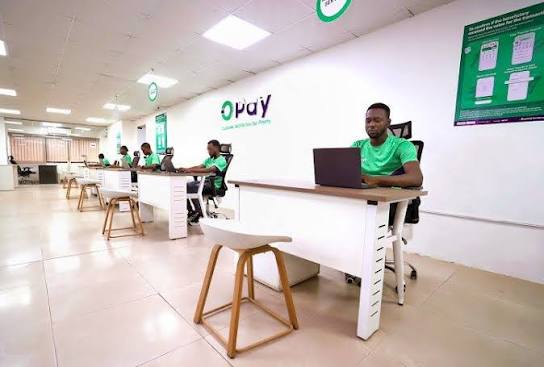
This is the most commercially significant comparison in Nigerian fintech for 2026, particularly in the context of the CBN’s April exclusivity rule that forces agents to choose definitively between them.
| Feature | Moniepoint | OPay |
|---|---|---|
| CBN licence type | National MFB (2025) | National MMO (Jan 2026) |
| 2025 transaction volume | ₦412 trillion / 14 billion transactions | 100 million+ daily transactions reported |
| POS market share | ~50% of Nigeria’s POS economy | 2 million+ service points |
| Agent/POS network | Largest merchant acquirer in Nigeria | Largest agent count by number |
| Business banking depth | Strong – accounts, cards, loans, Moniebook | Basic |
| Personal banking | Growing – separate personal app | Established consumer app |
| Working capital loans | Yes – ₦1 trillion disbursed in 2025 | Limited |
| Cashback rewards | Limited | Frequent – airtime, bills |
| Savings product | Business savings + personal savings | SafeBox |
| Security features | Standard biometric + PIN | NightGuard + Large Transaction Shield |
| Remittance | MonieWorld (UK to Nigeria, 2025) | None |
| Customer support | Average | Average |
| NDIC insurance | Yes (₦5M) | Yes (₦5M) |
| Stamp duty (2026) | ₦50 on ₦10k+ transfers | ₦50 on ₦10k+ transfers |
| Best for | Business owners and POS agents | Everyday consumers and cash access |
Choose Moniepoint over OPay if:
You operate or plan to operate a POS business as a primary income source. Moniepoint now controls approximately half of Nigeria’s POS economy – terminal brand recognition, commission settlement reliability, and business banking integration give Moniepoint a structural advantage for agents whose business depends on consistent performance. If you need working capital loans calibrated to your transaction history, Moniepoint’s data-driven credit product has no direct OPay equivalent. If you are an SME owner who wants payments, banking, loans, and business management in one platform, Moniepoint’s ecosystem depth is unmatched in the Nigerian market.
Choose OPay over Moniepoint if:
Your primary need is consumer payments – cheap daily transfers, bill payments, airtime cashback, and widespread cash access in secondary cities. OPay’s consumer-first product design, aggressive cashback promotions, and NightGuard security innovations serve everyday personal finance users better than Moniepoint’s business-oriented platform. If physical cash access across the broadest possible network is the priority, OPay’s 2 million+ service points provide slightly broader coverage in underserved areas than Moniepoint’s terminal network. If you want a personal fintech wallet as your primary daily spending account, OPay’s established consumer interface is more mature than Moniepoint’s newer personal banking product.
The one area where Moniepoint has no meaningful competitor:
Business banking depth for Nigerian SMEs. No other Nigerian fintech platform combines the POS infrastructure, dedicated business accounts, data-driven working capital lending, expense management, and business management tools at the scale and integration level Moniepoint provides. This is the structural moat that explains why investors including Google’s Africa Investment Fund and Visa committed $200 million in Moniepoint’s 2025 Series C.
Moniepoint operates two separate apps, a distinction that confuses many users searching for the platform.
Moniepoint Business Banking App
The original and primary Moniepoint product. Available on Google Play and App Store. Provides businesses with mobile banking solutions enabling them to create business bank accounts, accept online and offline payments, purchase airtime, pay utility bills, transfer money, request expense cards, and qualify for business loans.
Key features available in the business app: dedicated business account with unique account number, POS terminal management and transaction monitoring, expense cards for staff members, business savings plans, working capital loan application and management, Moniebook integration for bookkeeping, commission tracking for agents, and business transaction analytics.
The business app is the tool through which POS agents manage their terminal operations, track commissions, monitor transaction history, and access the full range of business banking features. It is mature, stable, and widely regarded as the most functional business banking app in the Nigerian fintech market.
Moniepoint Personal Banking App
A newer, separately downloaded app for individual users. Launched as Moniepoint’s personal banking solution, it offers debit cards to Nigerians using its terminals monthly, with an easy dispute resolution system ensuring funds reversal for failed card transactions.
Key features: personal bank account with unique account number, money transfers to all Nigerian banks, bill payments including electricity, cable TV, and airtime, personal savings plans, debit card with in-app dispute resolution, and spending tracking.
The personal app is designed for the tens of millions of Nigerians who interact with Moniepoint terminals daily and represents the platform’s expansion from B2B business banking into B2C personal banking. It is well-reviewed for interface simplicity but still behind the business app in feature maturity.
How to download:
Search “Moniepoint Business Banking” or “Moniepoint Personal Banking” on Google Play Store or Apple App Store. Ensure you are downloading the official Moniepoint app – both apps are published by Moniepoint MFB. Account opening requires BVN, NIN, and face verification.
Use Moniepoint if you are: A POS operator building agent banking as a primary or supplementary income source – Moniepoint’s reliability, commission structure, and business banking integration make it the strongest overall choice for full-time agents, particularly under the new single-principal CBN framework. An SME owner who needs a dedicated business account, integrated payments, and access to working capital loans without collateral requirements. A market trader or informal business operator who processes multiple daily payments and needs transaction infrastructure that does not require a minimum balance or formal account documentation beyond BVN and NIN. A Nigerian SME seeking business management tools – Moniebook for bookkeeping, savings plans, and expense cards – integrated with payment acceptance. A UK-based Nigerian who sends regular remittances home and wants a regulated, infrastructure-backed channel through MonieWorld.
Avoid Moniepoint if you: Want frequent cashback rewards on daily personal spending – OPay and PalmPay’s consumer reward programs are more developed and more consistent. Need a Mastercard or Visa card for international online transactions – Moniepoint’s cards do not support international payments. Require the full scope of commercial bank services including mortgage products, trade finance, or institutional-grade corporate banking. Cannot manage potential business disruption if terminal or account issues require multi-day resolution through customer support. Are looking primarily for a personal savings and investment platform with high-yield products – Piggyvest or Cowrywise offer more developed savings and investment features.
What usually goes right: For agents and business owners on normal operating days, Moniepoint works exactly as its reputation suggests – transactions process reliably, commissions settle daily, business accounts track activity accurately, and the POS infrastructure supports customer transactions without friction. Moniepoint’s 2025 figures showing 8 out of 10 in-person payments made through its platform are a reflection of operational reliability that users experience directly.
What usually goes wrong and when: Terminal faults – where a device stops processing transactions or communicates a hardware error – are the most disruptive failure mode for agents. Resolution typically requires contacting Moniepoint’s agent support channel and, in some cases, waiting for a field visit. This can take one to three business days. During this time, under the new single-principal rule, the agent has no alternative terminal. Account restrictions during compliance reviews follow the same pattern as other Nigerian fintechs – unusual transaction patterns trigger automated flags, human review takes time, and communication during the review period is inconsistent.
What most users underestimate: The seriousness of the April 2026 single-principal rule. Agents who previously maintained multiple terminals from different providers treated each relationship as low-commitment. Under the new framework, the choice of principal is a binding business decision. Agents should conduct genuine due diligence on Moniepoint’s support quality, terminal replacement timelines, and dispute resolution processes before committing exclusively.
How Moniepoint handles disputes: The card dispute resolution system for personal banking allows users to log and track disputes until full reversal. For agent terminal faults, the primary resolution channel is Moniepoint’s agent support – reachable through the business app and WhatsApp support groups organised by local government area. For unresolved disputes beyond ten working days, escalation to the CBN Consumer Protection Department at consumerprotection@cbn.gov.ng provides a regulatory channel that Moniepoint’s national MFB licence obligates it to respond to within defined timelines.
The Brands.Ng Conclusion
Moniepoint is the financial infrastructure of the Nigerian informal economy – a statement that is accurate, specific, and not reducible to any other fintech in the market.
Moniepoint claims that 8 out of 10 in-person payments in Nigeria are made with Moniepoint, processing ₦412 trillion and more than 14 billion transactions in 2025. At this scale, the platform is not competing with OPay or PalmPay for market position – it is competing with Nigeria’s commercial banking sector for relevance in the daily financial life of the economy’s largest employment and GDP contributor: the informal and SME sector.
Its genuine strengths are structural and durable. The POS network’s reliability. The business banking ecosystem’s depth for SMEs. The data-driven lending model that extends credit to businesses excluded from formal finance. The Series C backing from Google, Visa, and the IFC that confirms institutional confidence in the long-term trajectory.
Its weaknesses are proportional to its ambitions. Customer support that lags the platform’s operational scale. A regulatory environment that is tightening specifically around the POS and agent banking activities that are Moniepoint’s core strength. Credit risk that has grown alongside loan disbursement volumes. A personal banking product that is good but still maturing.
For business owners and POS agents, the decision calculus is clear: Moniepoint is the most complete, most reliable, and most business-oriented financial platform in Nigeria for your specific needs. The April 2026 single-principal rule makes that decision more consequential, not less correct – it simply means you should enter the relationship with clear expectations about what you are committing to.
Nigeria’s SME sector processes most of the country’s economic activity through tools that commercial banks built for corporations. Moniepoint is the first fintech to build specifically for that sector at national scale, and that specificity is why it processes more Nigerian transactions than any other single institution outside the commercial banking system.
Read this article to gain more clarity on Moniepoint vs OPay Agent (2026): Which Is Better for POS Business in Nigeria?
Editorial Note: This review reflects publicly available information, CBN regulatory records, and verified published data as of June 2026. Brands.ng does not receive payment for editorial coverage. Moniepoint was given the opportunity to respond to findings prior to publication. No response was received at time of publishing.