Last Updated: June 2026 Reviewed by: Brands.Ng Editorial Team
In May 2026, Baxi’s transfer service went down. Not for a few hours – for weeks. Agents publicly complained that the company had continued to ask them to remain patient while the issue stayed unresolved, and at least one user threatened to make TikTok videos tagging the company to force a response. Others worried that customers would accuse them of stealing money because transfers were hanging indefinitely. This was not a rogue incident. It was the most visible recent example of what lies underneath Baxi’s considerable strengths – a platform that works well most of the time and fails in ways that hit its most dependent users the hardest when it doesn’t.
That tension is the honest frame for this Baxi Mobile app review. Baxi is not a scam. It is not unsafe. It is, by most observable measures, one of Nigeria’s most structurally significant agency banking networks – with over 460,000 agents across all 36 states, more physical financial access points than most commercial banks can claim. It is also, like every platform of that scale, a system with structural failure modes that its marketing does not prepare users to understand.
Here is the full picture.
Legitimacy: Baxi is fully legitimate – licensed by the Central Bank of Nigeria through its parent company Capricorn Digital Limited (CDL), now operating under Onafriq (formerly MFS Africa) following a CBN-approved acquisition completed in 2022.
Safety: Funds transacted through Baxi are processed within a regulated CBN framework; the platform does not hold user deposits in a personal wallet, which limits exposure but also means no NDIC deposit insurance applies.
Best for: POS agents earning agent commissions, rural and peri-urban traders in states with limited bank branch access, SMEs needing multi-portal bill payment infrastructure, and businesses seeking B2B payment integration without building their own payment stack.
Biggest risk: Service interruptions – including the May 2026 transfer outage that lasted weeks – can freeze a POS agent’s core revenue stream with no guaranteed resolution timeline from the platform.
Brands.Ng Assessment: A structurally important, legitimately regulated agency banking platform whose agent network is its greatest asset and whose support infrastructure is its most material weakness.
- Founded: 2014 (as Capricorn Digital Limited, by Degbola Abudu)
- Parent company and ownership: MFS Africa (now trading as Onafriq), which completed its CBN-approved acquisition of Capricorn Digital Limited in March 2022
- Headquarters: 3, Murtala Muhammed International Airport Road, Ajao Estate, Lagos; also listed at Japaul House, Plot 8 Nurudeen Olowopopo Avenue, Agidingbi, Ikeja, Lagos
- Operational in: Nigeria (primary market); cross-border remittance capacity via Onafriq’s pan-African network
- Regulated by: Central Bank of Nigeria – Super Agent licence held through Capricorn Digital Limited; FCCPC-compliant for digital payment operations
- Core services: Agency banking (cash-in/cash-out via POS and mobile app), bill payments (electricity, cable TV, airtime, data), money transfers, account opening facilitation, business inventory management (BaxiRIMS), B2B payment integration
- Estimated agent network: Over 460,000 agents across all 36 states in Nigeria
- App platforms: Android (Google Play Store) and iOS (App Store)
- Notable backing: Onafriq (acquirer), which connects banks, telcos, and money transfer operators across over 35 countries and reaches approximately 320 million mobile money customers
- Transfer charges: ₦30 flat for transfers to any Nigerian bank, whether processed via app or POS
- Withdrawal charges: 0.5% for withdrawals between ₦1–₦20,000; flat ₦100 for transactions above ₦20,000
- Customer support: Phone – 02013438611; Email – support@baxi.com; Office – addresses above
- Loans: Baxi does not currently offer direct consumer or agent loans through the app
- Notable 2025/2026 development: Prolonged transfer service outage in May 2026; Onafriq rebranding continues to reshape Baxi’s parent company identity
Baxi is not a neobank. It does not hold customer deposits, does not issue debit cards to end consumers, and does not offer savings or investment products. Understanding what it is – as opposed to what it resembles – requires starting with its actual function in the Nigerian financial architecture.
Baxi is one of Nigeria’s largest independent non-bank SME-focused electronic payment networks, operating an omnichannel platform that enables digital payments through mobile, in-store locations, online wallets, and B2B channels. In plain language: Baxi is an agent network and payment infrastructure company. Its core product is the distribution of financial services – bill payments, cash withdrawals, money transfers, account opening – through a network of human agents equipped with POS hardware or the mobile app.
The business model operates on two layers simultaneously. On the agent side, Baxi generates revenue through per-transaction fees and provides agents with a commission structure that creates income for the operator. On the product side, it earns spread on airtime, utility, and data transactions processed through the platform. Neither layer is the secondary business; they are designed to reinforce each other. A dense agent network drives transaction volume, transaction volume justifies the commission structure, and the commission structure attracts more agents.
The operational reality in Nigeria is that Baxi is dependent on three infrastructure layers it does not control: Nigerian bank settlement rails, telco connectivity, and electricity. When any of those layers experience disruptions – bank system maintenance windows, telco congestion in specific states, power failures that affect device operation – Baxi’s service degrades in the last mile. This is not unique to Baxi. It is the structural reality of any platform that relies on Nigeria’s physical infrastructure to deliver digital financial services. What is specific to Baxi is the concentration of risk: agents who rely on Baxi as their primary income source absorb the full impact of disruptions that the platform can neither prevent nor always resolve quickly.
Since the Onafriq acquisition was completed, Baxi has been positioned as a major node on MFS Africa’s digital payment network, enabling users to send and receive cross-border payments to and from Nigeria – a capability that distinguishes it from purely domestic agency banking operators. This cross-border dimension, enabled by Onafriq’s connections to mobile money providers across 35 African countries, is the structural advantage that Baxi’s competitors cannot easily replicate.
What Baxi is not, despite how it is sometimes marketed: it is not a personal finance app. It is not a competitor to Kuda, Carbon, or OPay’s consumer wallet. It is a business-facing payment infrastructure platform that happens to have a consumer-accessible mobile application layer on top.
POS agents in states with limited bank coverage – In local government areas where commercial bank branches have never existed and ATMs fail as often as they work, a Baxi POS machine is frequently the only formal financial services point available. Baxi’s presence across all 36 states is not incidental – it is the product’s most important attribute for this user type. The agent earns commission on every transaction they facilitate; the community gains access to cash that would otherwise require a 45-minute commercial bus journey.
Market traders managing daily cash flow – A Yaba fabric trader or Alaba electronics dealer processing daily payments above ₦50,000 needs a withdrawal infrastructure that operates during market hours, not bank queue hours. The Baxi POS fills that gap with no daily transaction target – a deliberate design choice that sets it apart from competitors whose devices can be locked or retrieved based on daily transaction volume shortfalls.
Civil servants in secondary cities – A local government worker in Owerri or Makurdi whose salary arrives via NIBSS into their bank account but who lives 20 minutes from the nearest functioning ATM uses a Baxi agent as de facto cash infrastructure. The agent’s presence is consistent, local, and relationship-based in ways that bank branches are not.
SMEs needing bill payment consolidation – A school, clinic, or small manufacturing business that pays electricity bills across multiple premises, DStv subscriptions, and data plans for staff can consolidate these payments through the Baxi platform rather than managing multiple vendor relationships. The B2B integration layer allows businesses to embed Baxi’s payment catalogue into their own operations.
Diaspora remittance recipients – Through Onafriq’s network, recipients in Nigeria can collect cash from Baxi agents using a unique code generated for each international transaction, or receive funds directly into bank accounts. For recipients in areas without strong mobile banking penetration, the Baxi cash pickup option is functionally irreplaceable.
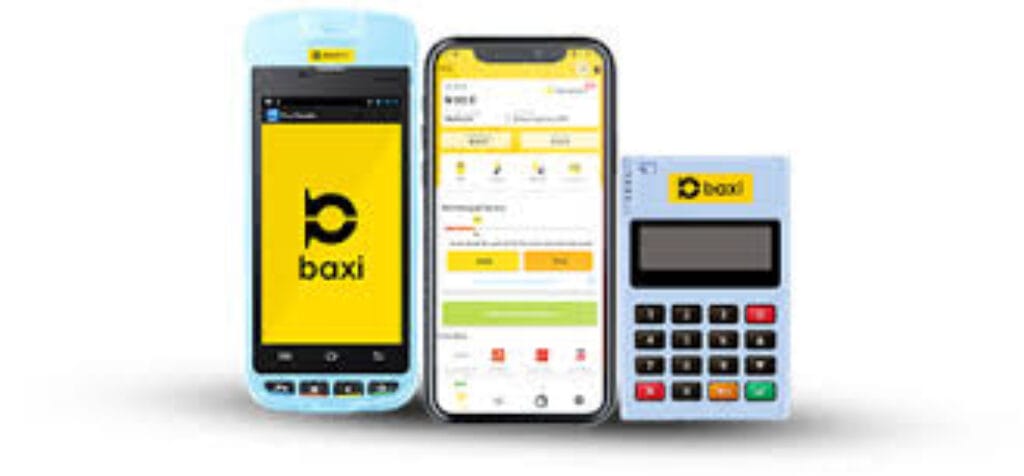
BaxiBox POS
What it does: A point-of-sale device – available as Android POS or MPOS – that enables card-present and transfer-based transactions for withdrawals, bill payments, and money transfers.
What it means in practice: The Android POS costs approximately ₦80,000 for outright purchase; the MPOS costs approximately ₦30,000, with cautionary fee (leasing) options available at lower upfront costs. There is no daily transaction target, which is a meaningful operational protection for agents in lower-volume locations who would otherwise face device retrieval from competitors with mandatory targets.
What to watch out for: The May 2026 transfer outage demonstrated that POS-dependent agents can lose their primary revenue stream for weeks when Baxi’s transfer infrastructure fails. Agents should maintain a backup payment channel – whether a secondary POS provider or a manual inter-bank transfer capability – rather than operating Baxi as their sole income tool.
Baxi Mobile App
What it does: A multi-service mobile application available on Android and iOS that provides the same core services as the POS – transfers, bill payments, airtime, data – accessible from a smartphone without requiring a physical POS device.
What it means in practice: The app enables micro-agents who cannot afford POS hardware to participate in the Baxi network immediately, lowering the barrier to entry for agency banking. Users receive a unique bank account number issued through Wema Bank or Rolez Bank on the Baxi app dashboard, which functions as a receivable account for transfers.
What to watch out for: The mobile app and POS share the same backend infrastructure. When the transfer service experienced its 2026 outage, both channels were affected simultaneously. App-only agents have no fallback to a different processing system on the same platform.
Bill Payment Platform
What it does: Processes electricity payments (across the distribution companies – Ikeja Electric, Eko Electric, Abuja DisCo, and others), cable TV subscriptions (DStv, GOtv, Startimes), airtime and data vending across MTN, Airtel, Glo, and T2mobile, and other utility payments in a single transaction flow.
What it means in practice: Agents earn a commission on every bill payment processed, creating a revenue stream that continues even when cash transaction volumes are low. For markets and communities that experience reduced footfall at certain times, bill payment commissions provide income stability that pure withdrawal/transfer agents lack.
What to watch out for: Baxi’s platform processes multiple bills in one transaction, which is an efficiency advantage – but if the platform experiences downtime during month-end billing cycles, when the majority of customers pay their utility bills, agents face the double pressure of peak demand and service unavailability simultaneously. This is precisely the period when Baxi failures cost the most.
B2B Integration (BaxiPay API)
What it does: Enables businesses to access and market Baxi’s products and services through their own channels via a relatively simple integration, allowing businesses to embed airtime vending, bill payment, and transfer capabilities into their own customer-facing applications.
What it means in practice: A supermarket chain, church platform, or school management system can offer bill payment and airtime to its own users without building payment infrastructure from scratch. The commission structure passes through the integrating business.
What to watch out for: This is a business-to-business product, not a consumer feature. Individual users cannot access the API benefits directly; the advantages flow to the businesses they transact with. Users who see Baxi branding in a third-party platform are likely experiencing a B2B integration, with Baxi as the backend rather than the product.
BaxiRIMS (Retail Inventory Management System)
What it does: A retail inventory management tool for store owners that tracks stock levels, manages reorders, and integrates with the broader Baxi payment infrastructure.
What it means in practice: For a POS agent who also operates a small provision store, RIMS provides basic inventory intelligence that would otherwise require a separate software subscription. It positions Baxi as a business operating system rather than simply a payment device provider.
What to watch out for: This feature is significantly less developed than Baxi’s core payment infrastructure and receives minimal mention in user reviews. Its practical utility for agents with high SKU counts or sophisticated inventory needs is limited compared to dedicated stock management platforms.
The transfer outage in May 2026 was not unprecedented – it was pattern.
When Baxi’s transfer service failed in May 2026, the company acknowledged that many users were facing difficulties and said its technical teams were actively working with relevant partners to restore and stabilise the affected service. However, the company said it could not provide a specific timeline for full resolution. That “cannot provide a timeline” response to a weeks-long outage affecting thousands of agents reveals the structural reality: Baxi’s settlement and transfer architecture runs through third-party banking partners whose restoration timelines are outside Baxi’s direct control. When those partners experience issues, Baxi can communicate but cannot unilaterally fix the problem. Agents who understand this will plan accordingly. Agents who treat Baxi’s transfer promises as unconditional will face avoidable shocks.
There are no loans – but many users don’t know that until they need one.
A pattern that emerges from public discussions is that users who join Baxi expecting a loan facility, as offered by OPay’s Okash product or Carbon, discover after onboarding that Baxi does not currently offer direct lending to agents or consumers through the mobile app. The company markets itself as a financial services platform, and the absence of a loan product creates a gap that many new agents expect to be filled. The structural reason is straightforward: Baxi’s CBN licence is a Super Agent licence, not a microfinance bank licence. Lending requires a different regulatory instrument that Baxi has not obtained, at least not for direct consumer deployment.
The fee structure carries a government tax that most users don’t account for.
The stated transfer fee of ₦30 and withdrawal charges of 0.5% or ₦100 are Baxi’s platform fees. They do not include the stamp duty on electronic transfers mandated under Nigerian tax law, which currently applies to qualifying transactions. Agents who calculate their margins based only on Baxi’s quoted fees consistently report net earnings slightly below their projections, with the discrepancy attributable to taxes they did not factor in. Building the stamp duty into daily cash flow calculations is a basic operational discipline that Baxi’s onboarding materials do not consistently emphasize.
What happens when an agent’s account is flagged for compliance, and why it takes so long to resolve.
A pattern that emerges from agent communities on Nairaland and WhatsApp groups is that accounts flagged for large or unusual transaction volumes can be suspended pending compliance review, a process that can take anywhere from 48 hours to several weeks depending on the nature of the flag and the documentation required to clear it. The structural reason is the CBN’s Know-Your-Customer and Anti-Money Laundering requirements, which mandate that Super Agents like Baxi monitor for suspicious transaction patterns and escalate flagged accounts for review. Agents who move large cash volumes should maintain up-to-date documentation and respond to compliance requests immediately, as delays in documentation extend the resolution window significantly.
The Onafriq acquisition changed who owns Baxi, but most agents don’t know who that is.
MFS Africa completed its acquisition of Capricorn Digital Limited – Baxi’s parent – in March 2022 with CBN approval. The company has since rebranded as Onafriq. The practical implication for Nigerian agents is that Baxi’s strategic direction is now set by a pan-African payments company based outside Nigeria whose primary focus is interoperability infrastructure across 35 countries, not the specific pain points of a POS agent in Aba. This is neither good nor bad in isolation – but agents who believe they are dealing with a Lagos-native SME-focused company are operating with an outdated mental model of who their platform provider actually is.
What users consistently praise:
The breadth of the bill payment catalogue draws consistent positive commentary – agents specifically note that being able to process DStv, PHCN, data, airtime, and bank transfers from a single app reduces the number of platforms they need to manage. The absence of a daily transaction target receives specific praise from agents in lower-volume locations who would face device retrieval or account suspension at competitors. Network reliability, on normal days, when the transfer infrastructure is functioning, is frequently cited as a relative strength compared to some competitors.
What users consistently criticize:
Transfer downtime events, particularly protracted ones like the May 2026 outage, generate sustained and intense criticism. The inability to predict when service will be restored is the specific complaint – agents are not simply frustrated by the failure; they are frustrated by the absence of credible information about resolution. Customer support responsiveness during service disruptions is consistently flagged as inadequate, with agents reporting that generic “we are working on it” communications replace specific operational guidance.
When problems most often occur:
Transfer failures cluster around periods of Nigerian bank system updates and year-end/quarter-end settlement windows, when the interbank settlement infrastructure that Baxi depends on is under higher load. Month-end utility payment peaks create high-volume demand on the bill payment side simultaneously, compressing agent margins for error. Network-related failures are disproportionately reported from states with weaker mobile connectivity infrastructure – primarily North-East and some North-West states.
Sentiment trend:
Public sentiment has not improved materially since the May 2026 transfer outage. Prior to that event, sentiment was stable and moderately positive among established agents. The outage reset trust levels for a significant portion of the agent community who were affected, and recovery depends on whether the company demonstrates improved service reliability and communication standards in subsequent months.
Is Baxi legitimate?
Yes. Baxi is licensed by the Central Bank of Nigeria through its parent company Capricorn Digital Limited, which is now owned by Onafriq following a CBN-approved acquisition completed in March 2022. The platform has operated continuously since 2014, processed over $1 billion in transactions, and operates under direct CBN regulatory oversight. There is no credible basis for classifying it as a scam, a fraudulent operation, or an unlicensed platform.
Is Baxi safe to use in Nigeria?
Safe for what it actually does – processing agency banking transactions within a CBN-regulated framework – yes. Users do not face predatory data harvesting, contact-based harassment, or hidden fee structures of the kind associated with unlicensed loan apps. What Baxi is not safe against is service disruption – a category of risk that is operational rather than fraudulent but which has real financial consequences for agents who treat the platform as their sole payment infrastructure.
What is the real risk?
Concentration risk. An agent who processes all of their daily volume through Baxi – withdrawals, transfers, bill payments – and has no backup payment channel faces complete revenue cessation when Baxi’s transfer service fails. The May 2026 outage demonstrated that this failure mode exists and that resolution timelines can be measured in weeks. The risk is not that Baxi will steal funds; it is that Baxi’s infrastructure will become unavailable at unpredictable times without a credible timeline for restoration.
What users misunderstand about safety:
Many users conflate “regulated” with “reliable.” CBN regulation ensures that Baxi operates within a legal framework and that consumer protections apply – it does not guarantee uptime, transfer speed, or the availability of any specific service at any specific moment. Regulation addresses fraud risk. It does not address operational risk. Both categories matter, and only one is guaranteed by Baxi’s regulatory status.
All fee and agent data based on publicly available information at time of writing. Verify current figures directly with each provider before making business decisions.
| Feature | Baxi | Moniepoint | OPay | Nomba (Kudi) |
|---|---|---|---|---|
| CBN licence type | Super Agent (via CDL) | Microfinance Bank | MFB + Payment Service Bank | Super Agent |
| Estimated agents | 460,000+ | 1,000,000+ | 500,000+ | Not disclosed |
| Transfer fee (inter-bank) | ₦30 flat | ~₦20–₦30 | Varies by tier | ₦20–₦30 |
| Withdrawal charge | 0.5% / ₦100 cap | 0.5% standard | 0.5–0.75% | Competitive |
| Daily transaction target | None | Required (varies) | Required (varies) | Varies |
| POS device price (Android) | ₦80,000 | ₦35,000–₦45,000 | ₦13,000–₦40,000 | ₦25,000–₦45,000 |
| Consumer loans offered | No | Yes | Yes (via Okash) | No |
| NDIC insurance on funds | No (not a deposit-holder) | Yes (MFB) | Yes (MFB) | No |
| Cross-border capability | Yes (via Onafriq) | Limited | Limited | No |
| Ideal for | Rural/peri-urban agents, B2B payment integration | High-volume urban agents, business banking | Consumer wallet users, urban merchants | SME payment infrastructure |
Who should choose Baxi over Moniepoint: An agent operating in a location that Moniepoint’s agent recruitment has not prioritized – smaller local government areas in states where Moniepoint’s density is low – will find Baxi’s 460,000-strong network already present, with established local support structures. The absence of a daily transaction target also makes Baxi structurally better for locations where daily volume is unpredictable, because the agent faces no device retrieval risk on slow days.
Who would be better served by Moniepoint: An agent processing high daily volumes in an urban or peri-urban location who needs the strongest possible uptime track record, the most comprehensive business banking integration, and access to working capital lending through the platform should choose Moniepoint. Moniepoint POS is ranked as the most reliable option in 2025 for agents who prioritize dependable performance and the lowest transaction charges. An agent who has experienced the Baxi May 2026 outage and cannot afford another multi-week revenue freeze has a specific functional reason to switch.
The one area where Baxi has no meaningful competition: Cross-border cash collection. Through Onafriq’s network, international senders can generate a unique code that recipients collect as cash at any Baxi agent across Nigeria. No domestic-only POS provider offers this capability. For agents in diaspora-heavy communities – Surulere, Festac, Isale Eko, or anywhere with high remittance inflows – the Baxi cross-border feature creates demand that no competitor can serve through the same channel. This advantage is structural rather than temporary: it derives from Onafriq’s ownership and its 35-country African interoperability network, which took over a decade to build.
Use Baxi if you are:
- A new POS agent in a rural LGA where Moniepoint has limited penetration and you need immediate market presence without waiting for competitor activation
- An agent specifically targeting diaspora remittance recipients who need cash collection for international transfers – the Onafriq cross-border capability is your unique selling point
- A business owner needing B2B payment integration without the cost of building proprietary payment infrastructure
- An agent in a lower-volume location who cannot meet competitor daily targets and needs a platform with no target-based device retrieval policy
- An SME operator needing a single platform for multi-utility bill payment management across electricity, cable, airtime, and data
Avoid Baxi if you:
- Depend on daily transfer volume as your primary income source and cannot sustain multiple weeks of revenue loss during a service outage
- Need access to agent working capital loans – Baxi does not offer this and you will need to supplement with Moniepoint, OPay, or a separate lender
- Require NDIC-insured fund protection for money held within the platform – Baxi’s Super Agent structure does not provide deposit insurance
- Are evaluating platforms primarily on POS device cost – Baxi’s Android POS at ₦80,000 is significantly more expensive than Moniepoint or OPay alternatives
- Have previously experienced a Baxi service outage and cannot absorb the operational risk of another
What usually goes right: On a normal operational day, Baxi processes bill payments, airtime, data, and cash withdrawals reliably. Agents in well-connected urban and peri-urban areas report consistent performance for these core functions. The bill payment platform, specifically, is regarded as dependable – utility vending and cable subscriptions process predictably across provider categories. The commission structure pays correctly and on schedule for agents operating within normal transaction parameters.
What usually goes wrong and when: Transfer failures are the primary failure mode. When Baxi’s transfer infrastructure experiences disruption, the company’s stated position is to continue working with relevant partners without committing to a specific restoration timeline – a communication posture that leaves agents unable to plan. Month-end periods, when cash withdrawal demand peaks alongside utility payment cycles, create the highest load on all system components simultaneously. Compliance-triggered account suspensions occur most frequently for agents who have recently scaled transaction volumes significantly without updating their KYC documentation.
What most users underestimate: The dependency chain. Baxi’s transfer service does not operate on Baxi infrastructure alone – it operates on a combination of Baxi’s systems, correspondent banking partners, and the Nigerian interbank settlement network. When any link in that chain fails, Baxi’s ability to restore service is contingent on actions by parties outside its control. Agents who understand this accept outages as a structural feature of the Nigerian payments landscape, not specifically a Baxi failure. Agents who do not understand this expect Baxi to have a resolution they cannot deliver.
How Baxi handles disputes: Phone support at 02013438611 is the fastest initial channel. Email at support@baxi.com processes within 24–48 hours for routine queries; complex disputes involving stuck transactions or compliance suspensions take significantly longer. For failed or pending transactions, Baxi’s recommended process is to retry, then contact customer support with full transaction details – date, amount, recipient – to enable investigation. Disputes that remain unresolved after internal escalation can be escalated to the CBN Consumer Protection Department at consumerprotection@cbn.gov.ng, which has jurisdiction over Super Agent operations.
Common Questions About Baxi Mobile App, Answered
How do I recover my Baxi username and password?
To recover your Baxi username, open the Baxi Mobile app and tap “Forgot Password” or “Forgot Username” on the login screen. You will be prompted to enter your registered phone number, after which an OTP (one-time password) is sent to that number for identity verification. If you no longer have access to your registered phone number, you must contact Baxi customer support directly at 02013438611 or support@baxi.com with proof of identity – a valid government-issued ID and the details used during registration – to begin a manual account recovery process. Attempting to create a new account with the same BVN will not work, as BVN duplication is flagged at the system level.
Is Baxi a bank?
No. Baxi is not a bank. It is a CBN-licensed Super Agent – a payments and agency banking platform – not a licensed commercial bank, microfinance bank, or financial holding company. Baxi is licensed by the Central Bank of Nigeria through its parent company Capricorn Digital Limited, but under a Super Agent licence that authorizes it to facilitate financial transactions as an agent, not to hold deposits in the banking sense. This distinction matters: funds processed through Baxi are not protected by NDIC deposit insurance the way they would be in a licensed bank account. Baxi’s wallet is a regulated payment instrument, not a bank deposit account.
How to apply for Baxi POS?
To apply for a Baxi POS, download the Baxi Mobile app from the Google Play Store or Apple Store, or visit the Baxi website and complete the agent application form. You will need a verified ID card (international passport, voters card, or driver’s licence), proof of address for yourself and a guarantor, and two passport photographs. For businesses, you will need a Certificate of Incorporation and CAC registration forms. After submission, expect approximately 48 hours for the Baxi team to review your application, after which your agent account is created, your location is verified, and you receive your starter pack. The Android POS costs approximately ₦80,000 for outright purchase; cautionary (lease) fee options are available at lower upfront costs.
What is the WhatsApp number for Baxi box?
Based on publicly available contact information, Baxi’s primary customer support channels are the phone line at 02013438611 and email at support@baxi.com. A dedicated WhatsApp contact number is not consistently confirmed across Baxi’s official communications – this is a channel that has changed in the past and is not reliable to list without current verification. For the most current WhatsApp contact details, check Baxi’s official website at baxi.ng or call 02013438611 to be directed to the current messaging channel. Do not use WhatsApp numbers listed on third-party sites without confirming them through Baxi’s official verified channels first, as fraudulent impersonator accounts targeting agents are a documented risk in Nigerian fintech platforms.
How to reset Baxi?
To reset your Baxi app PIN or account password, open the Baxi Mobile app and select “Forgot PIN” or “Forgot Password” from the login screen. Enter your registered phone number, receive the OTP, and follow the prompts to set a new PIN or password. To reset your Baxi POS device – if the device itself is locked or malfunctioning – contact Baxi customer support at 02013438611, as hardware resets require agent-side intervention from the Baxi technical team. Factory resets of the POS hardware should not be attempted independently, as they may deregister the device from the Baxi network, requiring a full re-onboarding process.
Baxi is Nigeria’s most geographically widespread agency banking network that nobody outside the agent community talks about – and the May 2026 transfer outage revealed exactly why that anonymity has a price.
The platform genuinely does one thing at a scale its competitors have not matched: it puts financial access points in all 36 states through over 460,000 agents, reaching communities where Moniepoint has not recruited, OPay has not deployed, and bank branches have never existed. That is not a marketing claim – it is a documented infrastructure fact with direct economic consequences for the Nigerians those agents serve. The cross-border cash collection capability, enabled by Onafriq’s pan-African network, adds a dimension that no domestic-only competitor can match.
Its most significant weakness is the support infrastructure behind that network. When the transfer service fails – and it does fail, sometimes for weeks – Baxi’s response mechanism defaults to patient communication with no timeline commitment. That is not a customer service failure. It is a structural limitation of a platform whose settlement architecture runs through third-party banking partners outside its direct control. Understanding the distinction matters, but it does not reduce the operational damage to agents who absorb it.
Use Baxi without reservation if you are an agent in an area where no serious competitor has deployed, if you need cross-border remittance cash collection capability, or if you need B2B payment integration. Use it alongside a backup provider if your livelihood depends on transfer availability. Do not use it as your only financial infrastructure.
Nigeria has 460,000 reasons Baxi matters – one for each agent whose income it enables – and that network is real enough to deserve honest analysis, not promotional coverage.
Editorial Note: This review reflects publicly available information and user-reported experiences as of June 2026. Brands.ng does not receive payment for editorial coverage. Baxi / Onafriq was given the opportunity to respond to findings prior to publication. No response was received at time of publishing.
Suggested articles: OPay Customer Care Nigeria: Channels That Work (2026) | OPay POS Machine: How to Get One, Charges & What Agents Earn | PalmPay Customer Care Number Nigeria (2026 Guide)
Stay ahead of the businesses shaping Nigeria.
Get important company developments, analysis, research and business intelligence from Brands.Ng directly on WhatsApp.