
The Number Carbon Shows You Is Not the Number That Matters
There is a number Carbon shows you when you apply for a loan. It is usually small — 2%, 3%, sometimes 5%. It sits next to the word “monthly” and it looks, to most borrowers, like a reasonable price to pay for fast cash.
That number is not wrong. But it is not the number that determines whether borrowing from Carbon is a good financial decision for you. The number that matters — the one that tells you what you are actually paying to borrow money — is the effective annual rate. And that number is almost never shown prominently, almost never explained clearly, and almost always significantly higher than the monthly figure implies.
This article does the maths that Carbon’s loan summary screen doesn’t. If you are considering a Carbon loan, or if you already have one and want to understand what it is costing you, read this before you accept — or before you accept another one.
Quick Reference: Carbon Interest Rate Summary
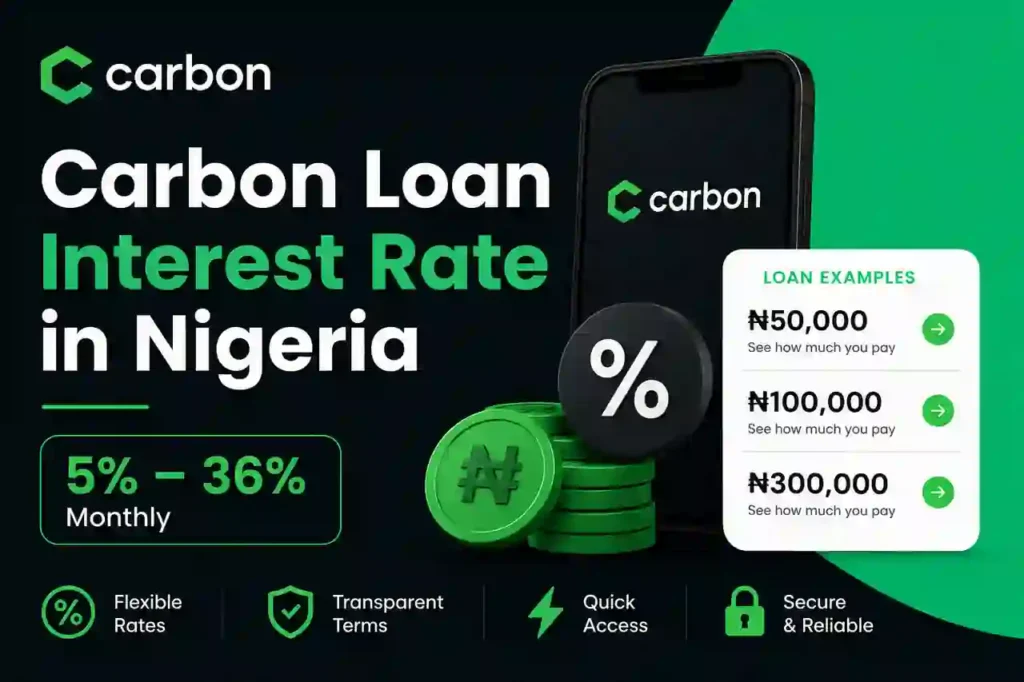
Advertised rate range: 5% to 36% per month (varies by user credit profile, loan amount, and tenor)
Effective annual rate range: Approximately 60% to 432% per year depending on rate applied
Typical rate for new borrowers: 10%–20% per month
Typical rate for established users with good repayment history: 5%–10% per month
Late payment penalty: Additional fees apply; exact structure varies — review your loan agreement
Credit bureau reporting: Yes — late and missed payments are reported to Nigerian credit bureaus
Brands.Ng bottom line: Carbon’s rates are within the legal range for CBN-licensed microfinance lenders but represent a high cost of borrowing that is only financially rational for genuine emergencies or short-tenor loans repaid immediately
What Carbon Actually Charges: The Rate Structure Explained
Carbon does not publish a single fixed interest rate. What it charges you depends on three factors working together: your credit profile as assessed by Carbon’s algorithm, the loan amount you are requesting, and the repayment tenor you select.
New borrowers with limited Carbon history typically receive rates in the 15%–25% monthly range. Returning borrowers who have demonstrated consistent on-time repayment progressively access lower rates — sometimes as low as 5% monthly for users with long, clean repayment records. This tiered structure is one of Carbon’s genuine design strengths: it creates a behavioral incentive for responsible borrowing that benefits the platform and the user simultaneously.
What the rate structure does not do is make the cost of borrowing transparent at the point of decision. Carbon displays the monthly rate and the total repayment amount. It does not convert that rate to an annualized figure in a way that most users will notice or understand. The result is a predictable information asymmetry: the lender understands the full cost of the loan; most borrowers do not.
The Maths: What Carbon Loans Actually Cost at Different Rate Tiers
The following calculations use Carbon’s reducing balance method — where interest is charged on the outstanding principal each month, reducing as repayments are made. This is the standard method and is more favourable to borrowers than a flat rate on the full original principal. All figures are approximate and illustrative.
Scenario 1: ₦50,000 loan at 10% monthly for 3 months
Monthly rate: 10% Month 1 interest: ₦5,000 (10% of ₦50,000) Month 2 interest: ₦3,333 (10% of ₦33,333 remaining after first repayment) Month 3 interest: ₦1,667 (10% of ₦16,667 remaining) Total interest paid: approximately ₦10,000 Total repayment: approximately ₦60,000 Effective cost: 20% of the borrowed amount over 3 months
A borrower who sees “10% monthly” and thinks “I’m paying ₦5,000 to borrow ₦50,000” is making a reasonable intuitive calculation for a one-month loan. For a three-month loan, the cumulative interest is double that initial intuition.
Scenario 2: ₦100,000 loan at 15% monthly for 6 months
This is a common borrowing scenario for Nigerian salary earners facing mid-month cash flow gaps.
Approximate total interest over 6 months at 15% monthly on reducing balance: ₦52,500 Total repayment: approximately ₦152,500 Effective cost: 52.5% of the borrowed amount
Put differently: for every ₦100 borrowed, the borrower returns ₦152.50. At 15% monthly, the effective annual rate is approximately 180%. If this feels high, it is — because it is. This does not make Carbon predatory. It makes Carbon an expensive product that serves a specific, urgent need and should be used accordingly.
Scenario 3: ₦300,000 loan at 8% monthly for 12 months
This represents a larger loan at a better rate — accessible to established Carbon users with strong repayment history.
Approximate total interest over 12 months at 8% monthly on reducing balance: ₦156,000 Total repayment: approximately ₦456,000 Effective cost: 52% of the borrowed amount Approximate effective annual rate: 96%
Even at Carbon’s more favourable rate tiers, a 12-month loan carries a borrowing cost that exceeds the original principal by a significant margin. For business working capital that generates a return exceeding 96% annually, this can be rational. For consumption spending or non-income-generating purposes, the long-term cost requires honest reckoning.
How Carbon’s Rates Compare to Alternatives
Understanding Carbon’s rates in isolation is less useful than understanding them in context.
Traditional commercial bank personal loans carry rates of 20%–30% per annum for eligible borrowers — significantly lower than Carbon’s effective annual rates. The tradeoff is eligibility: commercial banks require salary accounts, guarantors, payslips, and processing timelines of days to weeks. Carbon requires none of this. The rate premium Carbon charges is the price of accessibility.
FairMoney charges 2.5%–30% monthly depending on credit profile — a comparable range to Carbon, with slightly higher ceiling rates for high-risk borrowers. FairMoney offers larger loan amounts (up to ₦3,000,000 for individuals) but at rates that can exceed Carbon’s for equivalent credit profiles.
Branch Nigeria is generally regarded as having lower rates for established borrowers — sometimes as low as 2.1% monthly for loyal users — making it the lowest-cost major digital lender in Nigeria for qualifying users. The tradeoff is lower maximum loan limits compared to Carbon or FairMoney.
Informal money lenders — the ajo contribution, the colleagues’ loan, the market cooperative — carry social rather than financial costs. For small amounts between trusted parties, informal credit remains cheaper in pure financial terms than any digital lending platform.
The Situations Where Carbon’s Rate Is Financially Rational
Carbon’s interest rates are expensive. That does not mean using Carbon is always a poor decision. The rate is rational under specific conditions.
Short tenor, clear repayment source. A ₦30,000 loan repaid in full within one month at 10% monthly costs ₦3,000 in interest. If that ₦3,000 is the price of solving a genuine emergency — a medical bill, a rent shortfall, a business opportunity with a defined payoff — the cost is proportionate to the benefit. The problem arises when short-tenor loans roll into longer tenors because the repayment capacity assumed at origination did not materialise.
Credit building for future access. Users who borrow small amounts at higher rates, repay on time, and thereby unlock lower rates and higher limits on future borrowing are making a rational investment in their credit infrastructure. The cost of the early loans is partly an investment in cheaper future credit.
When no alternative exists at equivalent speed. At 2am on a Sunday when a family emergency requires immediate cash, Carbon’s 10-minute disbursement has no equivalent in the formal financial system. The rate premium reflects, in part, the value of that availability.
What You Should Do Before Accepting Any Carbon Loan
Calculate the total repayment amount, not just the monthly rate. Carbon shows you this figure on the loan summary screen. Look at it. Divide it by your monthly income. If the repayment exceeds 30% of your monthly net income, the loan is structurally risky regardless of how urgent the need feels.
Choose the shortest tenor that your cash flow can support. Longer tenors mean more monthly payments, each carrying interest. Shorter tenors cost more per month but less in total. For borrowers with the cash flow to support it, shorter is always cheaper.
Factor late payment costs into your decision. Carbon charges late payment fees and reports delinquency to credit bureaus. The true cost of a loan you cannot repay on time is the stated interest plus the penalty plus the credit bureau damage that affects your future borrowing across all Nigerian lenders.
Check your Carbon Zero eligibility before taking a standard loan. If you qualify for Carbon Zero — the zero-interest loan product available to users with strong repayment history — use it. The difference between a zero-interest loan and a 15% monthly loan on ₦30,000 is approximately ₦4,500 in interest that you simply don’t pay. It is worth checking before defaulting to the standard product.
Conclusion: Expensive, But Not Dishonest
Carbon’s interest rates are high. They are not hidden — the monthly rate and total repayment amount are disclosed before you accept any loan. What is absent is the annualized rate that would make comparison with other financial products straightforward. That absence is an industry-wide practice in Nigerian digital lending, not a Carbon-specific deception.
The honest conclusion is this: Carbon is an expensive source of credit that serves a genuine purpose for borrowers who need fast, collateral-free cash and understand what they are paying for it. It is not a product designed for long-term debt financing or for discretionary spending. Used correctly — for short-term emergencies with clear repayment plans — it is a legitimate and useful financial tool. Used carelessly — for discretionary spending, rolled over across multiple tenors, or taken without a clear repayment source — it is a fast route to a debt cycle that is difficult to exit.
Know which situation you are in before you tap “Accept Loan.”
Read more: Is Carbon Nigeria Legit? Full Review
Editorial Note: This analysis reflects publicly available information about Carbon’s loan products as of May 2026. Interest rate ranges are based on publicly disclosed figures and user-reported experiences. Individual rates vary by credit profile. Brands.Ng does not receive payment for editorial coverage.
Stay ahead of the businesses shaping Nigeria.
Get important company developments, analysis, research and business intelligence from Brands.Ng directly on WhatsApp.