Carbon Pink Passport Card Nigeria: Full Review of the Debit Card
Last Updated: June 2026
Carbon’s Debit Card Solves a Problem That Nigerian Bank Cards Create
Nigerian bank cards fail online at a rate that feels disproportionate to the digital payment infrastructure the country supposedly has. International transactions in particular — Netflix subscriptions, Shopify purchases, SaaS tool payments, Fiverr withdrawals, freelance platform fees — are where Nigerian debit cards most frequently fail, most mysteriously, and with the least helpful error messages.
Carbon’s Pink Passport card — both the virtual and physical Mastercard versions — exists specifically in this failure space. It is designed to work where Nigerian commercial bank cards often don’t: on international merchant platforms, online checkout systems, and subscription services that require reliable card authorization.
Whether it actually delivers on that promise, consistently and reliably, is what this review examines.
Quick Reference: Carbon Pink Passport Card
Card type: Mastercard debit (virtual and physical)
Linked to: Carbon account balance
Virtual card: Available immediately through the app for online and international transactions
Physical card: Requires request and delivery — timeline has historically been inconsistent
International transactions: Supported — primary use case differentiator
ATM withdrawals: Available on physical card
Card freeze/unfreeze: Available within the app
Card management: PIN reset, recurring payment setup, beneficiary renaming — all in-app
The Virtual Card: What It Does Well
The Carbon virtual card is the most immediately useful component of the card offering. It is generated within the app in seconds after account verification and provides a Mastercard card number, expiry date, and CVV that can be used immediately for online transactions.
For Nigerian users who need to pay for international subscriptions — Adobe Creative Cloud, Microsoft 365, Notion, Spotify — the virtual card works with notably higher reliability than many Nigerian commercial bank cards, which are frequently blocked by international merchants due to Nigerian card fraud risk profiles that banks have encoded into their authorization settings.
For freelancers receiving payments from Payoneer, Deel, or similar platforms who then need to spend those funds online, the Carbon virtual card provides a functional spending rail that does not require navigating the restrictions of a traditional bank card.
The card also supports one of the most genuinely useful features in Carbon’s banking toolkit: the ability to create multiple virtual cards for different purposes — one for subscriptions, one for one-time purchases, one for a specific vendor — with individual spending limits. This compartmentalization is a meaningful financial management tool.
The Physical Card: The Inconsistency Problem
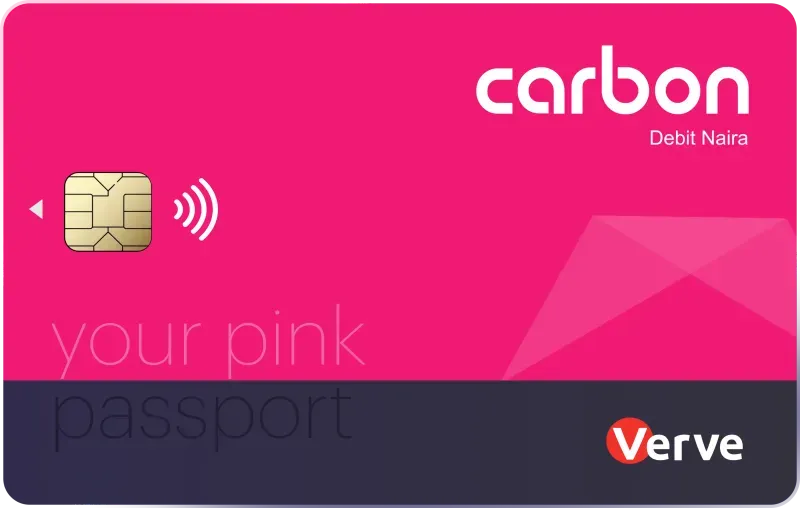
The Carbon physical Pink Passport card extends the Mastercard functionality to POS terminals and ATMs. The card design — which gives the product its “Pink Passport” branding — is distinctive and has been a minor social media marketing success for Carbon.
The operational problem is delivery. Physical card issuance timelines have historically been inconsistent, with users reporting waits ranging from one to three weeks in best cases to over six weeks in worst cases. This inconsistency does not appear to be resolved in the current product iteration — it reflects the operational complexity of physical card production and logistics in Nigeria.
For users whose primary need is online and international transactions, the virtual card satisfies that need without waiting for physical delivery. For users who specifically need a physical card for POS and ATM use, the delivery timeline uncertainty is worth factoring into your expectations.
The ATM Withdrawal Reality
The Carbon physical card works at Mastercard-accepting ATMs in Nigeria — which means the majority of ATMs operated by major commercial banks. ATM withdrawal fees apply: both Carbon’s own fee (where applicable) and the ATM owner’s interoperability fee if the ATM belongs to a different institution.
For regular ATM use, the Carbon card is functional but not meaningfully different from any other Mastercard-branded bank card. The card’s distinctive value is in online and international transactions, not cash withdrawals.
Card Security Features
Carbon’s in-app card management includes the ability to freeze your card instantly if it is lost or suspected compromised, unfreeze it when the situation is resolved, reset your card PIN, and set transaction limits. These controls are available 24 hours a day without requiring a call to customer service — which is the correct design for a digital-first card product.
For users who have previously dealt with the ordeal of blocking a compromised traditional bank card — waiting on hold, navigating IVR systems, visiting a branch — Carbon’s in-app card management is a genuine quality-of-life improvement.
Who the Carbon Card Is Most Useful For
The Pink Passport card delivers most value to three specific user types:
Freelancers and remote workers receiving international payments who need a card that works reliably on the international platforms where they earn and spend — Upwork, Fiverr, PayPal, Stripe, and their associated merchant networks.
Digital business owners who pay for SaaS tools, advertising platforms (Meta Ads, Google Ads), and cloud infrastructure in dollars or other currencies, and who have experienced Nigerian commercial bank card failures on these platforms.
Online shoppers who regularly purchase from international ecommerce platforms — Amazon, AliExpress, international fashion retailers — and need a card that international merchants accept without frequent authorization failures.
For users whose financial life is primarily domestic and cash-based, the Carbon card adds limited value over existing banking infrastructure.
Suggested reading: Is Carbon Nigeria Legit? Full Review | Carbon Savings Account Review | Carbon App Not Working? Troubleshooting Guide
Published by Brands.Ng — Africa’s Business Intelligence


Augustine Tom is the founder and publisher of Brands.Ng, an African business intelligence and digital economy platform covering fintech, ecommerce, logistics, startups, digital platforms, and consumer trust across Africa. He writes about branding, business growth, digital strategy, innovation, and emerging market trends, drawing from experience in business development, consulting, SEO, and digital marketing across diverse industries. His work focuses on analyzing the technologies, systems, and companies shaping Africa’s evolving digital economy.