
 Augustine Tom
Last Updated: June 2026
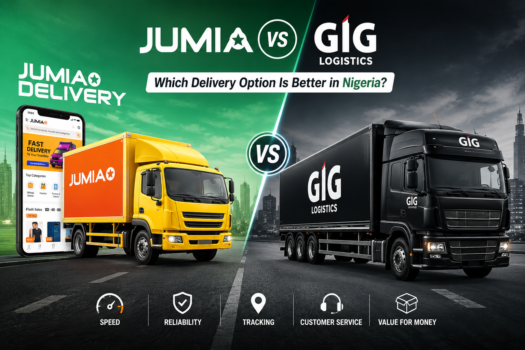
Most comparisons of Jumia and GIG Logistics miss the detail that actually matters most: these two services aren’t always competitors. Jumia Logistics and GIG Logistics both feature among the leading delivery operators in Nigeria’s e-commerce ecosystem, and in practice, GIGL’s infrastructure frequently moves Jumia’s own packages behind the scenes. The real decision isn’t “Jumia or GIGL” in the abstract — it’s whether you’re buying something (use Jumia) or sending something yourself (use GIG Logistics), and understanding that distinction changes how you should read every complaint and review you’ll encounter about either service.
What Jumia Delivery Actually Is
Jumia Delivery is built specifically to simplify logistics for Jumia’s sales channels, helping sellers reach customers reliably. It is not a courier you can hire independently of a Jumia transaction in the way you’d book GIG Logistics — it exists to move things bought and sold on Jumia’s platform.
The infrastructure behind it is more extensive than most users realise: Jumia operates over 283 Pick-Up Points, including Vendor Drop-off points (VDOs), across more than 107 cities spanning all 36 Nigerian states, with real-time tracking that lets both sellers and customers monitor a package’s journey from drop-off to pickup. That network density explains why Jumia delivery feels fast and reliable in Lagos specifically — the infrastructure is genuinely dense there — and noticeably less predictable the further a delivery travels from that core.
The delivery timeline gap between marketing and lived experience is the single most consistent complaint pattern across review platforms. One long-term Jumia user describes the platform as fast in delivery compared to competitors and generally reliable with a wide range of goods at competitive prices — but flags that refund duration for chargebacks or damaged goods, and customer care response time, remain genuine weak points. That mixed verdict — fast when it works, slow to fix when it doesn’t — repeats across dozens of independent reviews.
The structural reason delays happen has shifted over time, and most older comparison articles haven’t caught up. Jumia’s Nigeria operation has been forced to design around failure rather than assume reliability, because road congestion in Lagos, the lack of standardized addressing outside major cities, and erratic power supply are persistent features of the operating environment, not temporary problems that improve with scale. This is precisely why Jumia shut down the unprofitable Jumia Food vertical in December 2023 and cut West Africa marketing spend by nearly 20% between 2023 and 2024 — a deliberate strategic narrowing toward protecting delivery reliability and unit economics rather than chasing order volume growth. In plain terms: Jumia today is optimised more for consistent fulfilment than for aggressive expansion, which is a meaningfully different company than the Jumia of five years ago.
What GIG Logistics Actually Is
GIG Logistics (GIGL) is a standalone logistics company you can use for literally anything — documents, commercial goods, personal items — independent of any shopping platform.
Founded in 2012 by parent company God is Good Transport, GIGL operates 100+ service centres across all 36 Nigerian states, with over 150 experience centres providing nationwide coverage as of 2026, and last-mile delivery reaching beyond Nigeria’s borders into the UK, USA, Canada, and Ghana.
The verified delivery speed claims, stated precisely: GIGL’s GoFaster Interstate express service delivers in 24-48 hours between major cities including Lagos, Abuja, Port Harcourt, Kano, Benin, Ilorin, Ibadan, Uyo, Calabar, Owerri, Enugu, Kaduna, Yola, Sokoto, and Jos. Standard domestic delivery elsewhere in Nigeria runs 2-5 business days depending on zone and region, with same-day delivery available in select cities.
That 24-48 hour figure applies specifically to the major-city corridor — a genuinely fast, reliable claim within that network. Outside it, the honest range widens to the standard 2-5 day window, which is competitive but not exceptional compared to other domestic Nigerian couriers.
How Reliable Is GIG Logistics?
The honest answer requires separating GIGL’s infrastructure reliability from its customer service reliability — they are not the same metric, and conflating them produces misleading conclusions in either direction.
On infrastructure and tracking, GIGL performs strongly relative to Nigerian domestic competitors. GIG Logistics deploys proprietary tracking infrastructure specifically to capture premium pricing in southern urban corridors — meaning the tracking investment is a deliberate competitive differentiator, not an afterthought. Independent regional logistics rankings across multiple Nigerian cities consistently place GIG Logistics among the top providers for strong tracking, established reputation, and wide network coverage.
On customer support response, the pattern across review sources is more mixed. Across forum discussions and review aggregators, the recurring GIGL complaint isn’t lost or damaged packages — it’s slow resolution once an issue arises, and inconsistent communication during delays. This mirrors a broader truth about Nigerian logistics generally: the technology and tracking infrastructure has advanced faster than the human support layer behind it.
The honest verdict on reliability: GIG Logistics is structurally the more dependable choice for predictable point-to-point delivery — you know roughly what you’re paying, roughly when it will arrive, and you can track it the entire way. What it doesn’t reliably solve is fast human intervention when something does go wrong, which remains a genuine weak point regardless of how good the underlying tracking technology is.
How Fast Is GIG Logistics?
Specifically, by service tier:
| GIGL Service | Coverage | Verified Delivery Window |
|---|---|---|
| GoFaster Interstate Express | Major cities (Lagos, Abuja, PH, Kano, etc.) | 24–48 hours |
| Standard domestic | All 36 states | 2–5 business days |
| Same-day delivery | Select cities only | Same day |
| Last-mile international | UK, USA, Canada, Ghana | Varies by destination |
| International export | 230+ global destinations | Days to weeks depending on route |
Speeds reflect publicly available GIGL service data as of 2026. Actual delivery time varies with peak season demand, weather, and specific route conditions — always confirm current estimates directly through the GIGGo App before time-sensitive shipments.
The practical takeaway: if your route falls within GIGL’s named GoFaster corridor cities, 24-48 hours is a realistic, verifiable expectation. Outside that specific list, budget for the standard 2-5 day window rather than assuming express speed applies everywhere in the network.
Jumia vs GIG Logistics: Direct Comparison
| Criteria | Jumia Delivery | GIG Logistics |
|---|---|---|
| What it is | Integrated e-commerce fulfilment | Standalone logistics company |
| Who can use it | Only for items bought on Jumia | Anyone, for anything |
| Pickup/drop-off network | 283+ points across 107 cities, 36 states | 150+ experience centres, all 36 states |
| Fastest delivery claim | 1-3 days (Lagos best case) | 24-48 hours (named major-city corridor) |
| Realistic delivery range | 1-7+ days depending on seller and location | 1-5 business days depending on zone |
| Cost transparency | Bundled into checkout; often opaque | Clear weight-and-distance pricing |
| International reach | Jumia Global: 10-20 days from abroad | 230+ destinations; UK/US/Canada/Ghana last-mile |
| Primary failure point | Seller fulfilment delays, not logistics itself | Customer support response speed |
| Best for | Buying products online | Sending packages, documents, business shipments |
Also Read: Best Logistics Company in Nigeria for Ecommerce in 2026: A Seller’s Honest Guide
Which Is Better: Amazon or Jumia?
This comparison sits outside the Jumia-vs-GIGL logistics question, but it’s frequently searched alongside it — and the honest answer hinges on a structural fact most comparisons skip: Amazon does not operate a retail storefront in Nigeria. There is no Amazon.ng. Nigerians who “use Amazon” are either ordering through Amazon’s US or UK site with international shipping (slow, expensive, and subject to customs duties on arrival), or using a proxy/forwarding service that adds its own fees and timeline.
Jumia, by contrast, offers Jumia Global specifically to bridge this gap — partnering with foreign distributors and sellers from the United States, China, and Dubai, with delivery guaranteed within 10 to 20 days, and all customs duties, import duties, and international/national transportation costs already included in the displayed price, protecting buyers against potential revaluation surprises during customs clearance.
For a Nigerian buyer specifically: Jumia is the more practical choice for nearly everything, precisely because it operates with local currency pricing, local customer service (however imperfect), local returns infrastructure, and pre-cleared customs costs. Amazon becomes the better choice only for items genuinely unavailable on Jumia or any African platform — niche electronics, specific brands, or products requiring guaranteed authenticity that justify the extended wait and customs exposure of direct international shipping.
Which Is More Reliable: Konga or Jumia?
Both platforms ultimately depend on overlapping logistics infrastructure rather than running entirely separate operations — a structural fact that changes how this comparison should actually be read.
KOS Deliveries, Konga’s dedicated logistics arm, dispatches Konga’s e-commerce orders nationwide and is a solid pick specifically if you sell on Konga or run an e-commerce store, supporting pay-on-delivery. Meanwhile, third-party logistics companies across multiple Nigerian cities explicitly serve both Jumia and Konga sellers interchangeably for returns, pickups, and e-commerce movement — meaning the same regional courier may be physically delivering both your Jumia and Konga order.
This explains a pattern that confuses many Nigerian online shoppers: “Which E-commerce Company Delivers Faster — Konga or Jumia” has been a recurring, unresolved discussion across Nigerian online forums for years, without a clean consensus winner — because the actual delivery experience often depends more on which specific seller you bought from and which regional courier partner handled that specific order, than on the platform brand itself.
The more useful framing than “which is more reliable”: Jumia has the larger scale, broader product catalogue, and more extensive Pick-Up Point network nationally. Konga has historically positioned itself with a more curated, business-and-electronics-focused catalogue and its own KOS delivery arm. Neither platform’s delivery reliability is meaningfully superior in absolute terms — both inherit the same underlying Nigerian logistics constraints (address inconsistency, last-mile coordination, seller-side fulfilment delays) that affect every e-commerce operator in the market.
Real Scenarios: Which Service Actually Fits Your Situation
Buying a phone or electronics for personal use → Jumia, specifically because of integrated payment, the option for pay-on-delivery, and Jumia Global’s pre-cleared customs pricing if the item ships from abroad.
Sending business inventory from Lagos to Abuja for resale → GIG Logistics, because you need a courier you can book independently of any specific sale, with clear weight-and-distance pricing you can build into your margin calculations.
Sending an urgent legal document same-week → GIG Logistics’ GoFaster service if both cities are on the named express corridor; otherwise, consider DHL or FedEx for guaranteed international-grade timing if the deadline is truly non-negotiable.
Running a small e-commerce business selling on Instagram, not Jumia → GIG Logistics or Kwik, since Jumia Delivery as a service exists only for transactions completed on Jumia’s own platform — you cannot use Jumia’s logistics network for an independent sale made elsewhere.
Takeaway
Jumia and GIG Logistics solve different problems, and the comparison only produces a useful answer once you stop treating them as competitors. Jumia is commerce-with-built-in-delivery — convenient, increasingly disciplined about fulfilment reliability since its 2023-2024 strategic reset, but still only usable for items purchased on its own platform. GIG Logistics is delivery-as-pure-infrastructure — usable for anything, more transparent on pricing, structurally strong on tracking, but no faster at resolving problems once they occur than the rest of Nigeria’s logistics industry.
Choose Jumia when you’re buying. Choose GIG Logistics when you’re sending. The platform brand matters far less than that single distinction.
Editorial Note: This article reflects publicly available delivery data, customer reviews, and industry reporting as of June 2026. Brands.Ng does not receive payment for editorial coverage of any courier or e-commerce platform mentioned.