
One of the most expensive misconceptions in modern business is the belief that top employees primarily leave because of money. Many employees do not leave companies solely because of salary.
Compensation matters, and in some cases it matters significantly. But across many Nigerian and African businesses, high-performing employees often leave for a deeper operational reason: they stop trusting leadership systems internally.
That distinction is important because employees do not experience companies through mission statements or branding language. They experience organizations through daily operational behavior — communication patterns, escalation systems, decision consistency, meeting culture, accountability structures, operational coordination, and the emotional stability of leadership itself.
A founder may genuinely believe the company is ambitious, innovative, and fast-growing. Employees, however, may experience that same environment as psychologically exhausting, unpredictable, and operationally chaotic. That perception gap quietly erodes trust and eventually damages retention.
The pressure becomes even more intense in African operating environments where many workers are already managing external instability outside the workplace. Employees are simultaneously dealing with transportation stress, inflation pressure, unreliable electricity, fragmented healthcare systems, financial uncertainty, and broader infrastructure fatigue.
Under those conditions, poorly coordinated leadership does not simply reduce morale. It compounds existing life stress.
Increasingly, talented employees are deciding that even economic uncertainty is preferable to remaining inside systems that consistently generate operational anxiety.
Search Intent Analysis
The visible search intent behind this topic appears simple:
- “Why do employees leave companies?”
- “Leadership mistakes”
- “How to retain top talent”
But the deeper intent is more operational and emotional. Founders, executives, HR leaders, and business operators are often trying to solve a more painful problem:
“Why are strong employees becoming emotionally detached even when the company is growing?”
Many businesses assume employee exits are primarily compensation problems. In practice, many resignations are trust failures disguised as career decisions.
Especially across African businesses where:
- operational stress is already high,
- infrastructure friction is constant,
- job markets are unstable,
- and skilled employees increasingly have remote alternatives.
This changes employee psychology significantly.
Workers are no longer only evaluating:
- salary,
- titles,
- or perks.
Increasingly, they are evaluating:
- psychological stability,
- operational predictability,
- leadership reliability,
- communication clarity,
- and whether working inside the company feels emotionally exhausting.
Emotional Intent Analysis
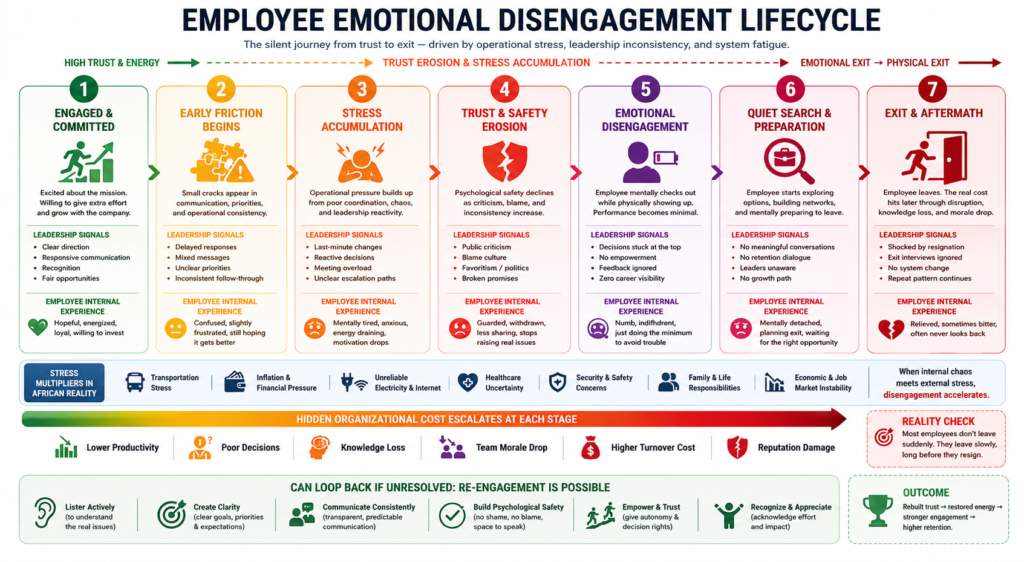
The emotional layer behind this topic is rarely discussed openly. Many founders feel confused after losing strong employees because:
- the company is growing,
- salaries may be competitive,
- products are improving,
- and opportunities appear promising externally.
Yet internally:
- frustration accumulates,
- emotional trust deteriorates,
- and high performers quietly disengage long before resigning.
Meanwhile, employees often leave not because of one catastrophic event, but because of accumulated operational fatigue.
The emotional reality is this:
Top employees rarely leave suddenly.
Most psychologically leave months earlier.
The Biggest Leadership Mistake Is Often Invisible
Many companies assume employee retention problems begin when workers submit resignation letters. Operationally, that is already the late stage of the problem.
In most organizations, retention deterioration begins much earlier through repeated micro-failures that leadership teams often underestimate or dismiss as minor workplace tension. These failures typically include inconsistent communication, unpredictable priorities, unclear expectations, emotionally reactive management behavior, excessive meetings, public criticism, delayed decision-making, or constantly shifting execution direction.
Individually, each incident may appear insignificant. Collectively, however, they create something far more damaging: operational trust erosion.
This form of trust matters more than many businesses realize, particularly among high-performing employees. Strong employees are rarely optimizing for salary alone. They are also evaluating the quality of the system they operate within.
They look for clarity, competence, predictability, execution quality, career momentum, and psychological stability. When those conditions begin deteriorating consistently, disengagement accelerates quietly long before formal resignation occurs.
In many cases, employees emotionally exit the organization months before they physically leave it — even when compensation remains competitive.
Why High Performers React Differently to Leadership Chaos
One hidden organizational reality is that top employees often experience dysfunctional systems more intensely than average employees.
This sounds counterintuitive initially. But operationally, it makes sense.
High performers tend to:
- notice inefficiencies faster,
- care more deeply about execution quality,
- anticipate downstream problems earlier,
- and absorb more organizational pressure.
Which means leadership inconsistency affects them disproportionately.
For example: A poorly coordinated company meeting may feel mildly annoying to average staff.
To a highly capable operations lead, it may signal:
- strategic confusion,
- leadership indecisiveness,
- weak coordination systems,
- or scaling fragility.
That interpretation changes retention risk dramatically. Because top employees are often evaluating:
“Can this company scale sustainably?”
Not merely:
“Is this job acceptable today?”
The Leadership Communication Problem Most Founders Misunderstand
Many leaders believe employees mainly want motivation. In practice, experienced employees usually want:
- clarity,
- predictability,
- coordination,
- and emotional steadiness.
This is particularly true in African startups and SMEs where operational volatility is already high.
When leadership communication becomes inconsistent, employees subconsciously begin calculating hidden stress costs.
These include:
- uncertainty,
- escalation anxiety,
- emotional exhaustion,
- reputational exposure,
- political navigation,
- and cognitive overload.
A developer in Lagos dealing with:
- unstable internet,
- fuel costs,
- electricity backup,
- and rising living expenses
may tolerate difficult work.
What often becomes intolerable is:
- avoidable internal chaos.
That distinction matters enormously.
Why Public Criticism Quietly Destroys Organizational Trust
One of the fastest ways leaders lose strong employees is through performative pressure culture.
Especially:
- public humiliation,
- emotional outbursts,
- reactive criticism,
- blame-heavy meetings,
- or unpredictable escalation behavior.
Many founders underestimate the second-order effects of this.
The issue is not merely morale. It is psychological safety degradation.
Once employees begin fearing embarrassment more than failure itself:
- information quality drops,
- escalation slows,
- mistakes get hidden,
- innovation declines,
- and execution accuracy deteriorates.
Ironically, some leaders create aggressive cultures believing it improves performance.
Operationally, it often reduces organizational intelligence. Because employees stop surfacing problems early.
The Hidden Operational Problem: Leadership Bottlenecks
A major reason many African companies struggle to retain strong talent is that leadership itself becomes the bottleneck.
This happens when:
- every decision requires founder approval,
- teams lack autonomy,
- priorities constantly change,
- escalation paths are unclear,
- or executives operate reactively instead of systematically.
At small scale, this can appear manageable. At growth stage, it becomes exhausting. Especially for ambitious employees.
One operational pattern appears repeatedly across startups and SMEs:
Founders often confuse:
- control
with - operational competence.
But excessive founder dependency creates:
- decision delays,
- execution confusion,
- meeting congestion,
- approval fatigue,
- and coordination paralysis.
Top employees eventually interpret this as:
“The company cannot scale operationally.”
That realization quietly increases attrition risk.
Reality Layer: What Actually Happens In Practice
In theory, employees leave for:
- better opportunities,
- compensation,
- or career growth.
In practice, many departures are accumulated stress responses. A marketing manager may resign after receiving a better offer.
But the deeper reason may involve months of:
- inconsistent leadership direction,
- emergency weekend work,
- delayed approvals,
- public criticism,
- unclear KPIs,
- and operational unpredictability.
The new offer simply becomes the exit opportunity.
This is particularly common inside rapidly growing African businesses where:
- systems mature slower than revenue,
- operational processes remain informal,
- and leadership coordination cannot keep pace with scaling demands.
Employees initially tolerate this during early growth excitement.
Over time, tolerance declines.
Especially among skilled workers with:
- remote opportunities,
- international exposure,
- or strong professional networks.
Why Top Employees Sometimes Leave “Good Companies”
Another uncomfortable reality:
A company can have:
- good products,
- ambitious vision,
- smart founders,
- and growing revenue,
while still becoming emotionally exhausting internally.
This confuses many leadership teams. But employees experience businesses operationally, not aspirationally.
They experience:
- calendar chaos,
- communication behavior,
- deadline coordination,
- escalation systems,
- feedback quality,
- and leadership emotional consistency.
A company may externally appear successful while internally operating with:
- chronic coordination stress,
- fragmented execution,
- and burnout normalization.
Employees eventually optimize for sustainability.
Not merely opportunity.
Why Common Internet Advice Is Incomplete
A large amount of management advice online oversimplifies employee retention. Typical recommendations include:
- “Pay employees more.”
- “Offer perks.”
- “Create positive culture.”
- “Reward hard work.”
These are incomplete. Because many retention problems are structural, not motivational.
For example:
A company may increase salaries while still maintaining:
- chaotic decision-making,
- inconsistent communication,
- operational ambiguity,
- reactive leadership,
- and poor escalation systems.
In that environment, compensation temporarily masks stress. It does not eliminate it.
This explains why some companies with high salaries still experience:
- burnout,
- disengagement,
- and high attrition among top performers.
Operational friction compounds psychologically over time.
Especially when employees believe leadership is aware of the dysfunction but unwilling to address it structurally.
Tradeoff Analysis: The Leadership Scaling Trap
One nuanced challenge many founders face is that leadership behaviors that work early can become destructive later.
For example: Extreme founder involvement may help survival during early-stage chaos.
But at scale, the same behavior can:
- slow decisions,
- undermine autonomy,
- create approval bottlenecks,
- and frustrate experienced operators.
Similarly:
- aggressive urgency culture
may initially accelerate execution.
But over time, it often creates:
- burnout,
- coordination fatigue,
- reduced creativity,
- and employee distrust.
This creates a difficult tradeoff.
Businesses need:
- urgency,
- accountability,
- and speed.
But excessive operational pressure without systems maturity eventually damages retention. Especially among highly capable employees.
Strategic Insight
The companies retaining top talent most effectively are increasingly not the companies with the most impressive branding. They are the companies that reduce internal operational anxiety.
This is becoming a major competitive advantage. Especially in African economies where external life stress is already high.
Employees increasingly value:
- emotionally stable leadership,
- predictable systems,
- clear communication,
- operational calm,
- and coordination reliability.
In many organizations, leadership quality is no longer judged primarily by charisma or vision.
Increasingly, it is judged by:
“How much unnecessary stress does this leadership team create operationally?”
That question quietly determines retention more than many executives realize.
Conclusion With Nuanced Takeaway
The leadership mistakes that push top employees away are often less dramatic than businesses assume. Most retention failures do not begin with scandal. They begin with accumulated operational inconsistency.
Top employees rarely expect perfect organizations. What they increasingly expect is:
- clarity,
- coordination,
- predictability,
- emotional maturity,
- and operational trustworthiness.
Especially in African business environments where external instability is already high.
Companies that fail to reduce internal chaos eventually create hidden organizational taxes:
- cognitive fatigue,
- emotional exhaustion,
- trust deterioration,
- and execution burnout.
And increasingly, talented employees are making decisions accordingly. Not because they lack loyalty. But because operational stress compounds. Eventually, people optimize for sustainability.
Stay ahead of the businesses shaping Nigeria.
Get important company developments, analysis, research and business intelligence from Brands.Ng directly on WhatsApp.