
When an OPay transfer fails mid-transaction – or when the app returns a limit error at the worst possible moment – most users experience it as a platform failure. The reality is more structural than that. Your OPay transfer limit is not a product decision. It is a regulatory architecture, built by the Central Bank of Nigeria and operationalised through a KYC tier system that determines how much financial infrastructure you are permitted to access based on how thoroughly you have identified yourself to the platform. Understanding that architecture does not just help you avoid failed transfers. It explains why mobile money in Nigeria is designed the way it is.
Why Your KYC Tier Determines More Than Just Your Limit
The CBN’s tiered KYC framework was not designed for OPay specifically – it was designed for the entire mobile money and fintech ecosystem, with OPay, Kuda, Moniepoint, PalmPay, and others all operating within the same regulatory architecture. The rationale is a direct tradeoff between financial inclusion and fraud exposure. Lowering the barrier to account creation means more Nigerians gain access to digital finance. Removing KYC requirements entirely means the system becomes a conduit for fraud, money laundering, and identity-based financial crime.
The tier structure is CBN’s resolution of that tension: easier entry at lower tiers with tighter operational limits, more access at higher tiers with more identity exposure required. For OPay – which operates as a CBN-licensed Mobile Money Operator and is also insured by the Nigeria Deposit Insurance Corporation (NDIC) – the limits are not internally negotiable. They are externally mandated.
This has a direct operational implication for OPay users: the platform cannot override your tier limit on a case-by-case basis regardless of your account history, transaction frequency, or customer relationship. The only path to a higher limit is a higher tier, which requires verified identity documentation at each level.
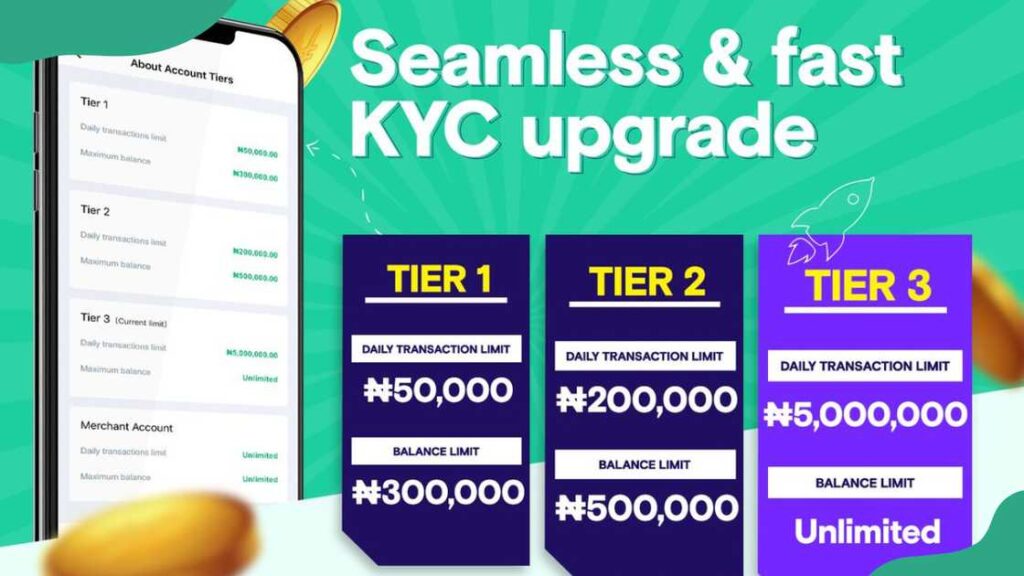
OPay KYC Tiers and Transfer Limits – 2026 Overview
| Account Tier | Daily Transfer Limit | Max Account Balance | KYC Requirement |
| Opay Tier 1 | ₦50,000 | ₦300,000 | Phone number + BVN or NIN (mandatory since March 2024) |
| Opay Tier 2 | ₦200,000 | ₦500,000 | BVN + valid government-issued ID + date of birth + email + proof of address |
| Opay Tier 3 | ₦5,000,000 | Unlimited | Full KYC: BVN + NIN + valid ID + additional verification at OPay’s discretion |
Note: These figures reflect publicly available OPay data and CBN guidelines as of May 2026. OPay reserves the right to adjust internal limits within CBN-mandated ceilings. Always verify current limits directly on the OPay app or at opay.com before making time-sensitive decisions.
The March 2024 CBN Directive That Changed Everything
Before March 2024, Tier 1 OPay accounts could be opened with a phone number alone. No BVN. No NIN. This was intentional financial inclusion policy: reduce friction at the entry point to bring unbanked Nigerians into the digital economy. The tradeoff was a proliferation of unverified accounts that became vectors for fraud, SIM-swap attacks, and identity-based scams.
The CBN’s directive, fully effective March 2024, ended that era. BVN or NIN linkage is now mandatory for all OPay accounts to hold any balance or conduct any transaction – including Tier 1. This is not OPay policy. It applies across every CBN-licensed fintech, including PalmPay, Kuda, and Moniepoint. The operational consequence is that the old mental model of OPay as a frictionless wallet you can open in 60 seconds no longer holds. Every account now requires a verified identity anchor.
OPERATIONAL OBSERVATION
A significant but underreported consequence of the March 2024 directive is the dormant account problem. Millions of OPay accounts created before the directive without BVN linkage were effectively frozen – unable to transact until verification was completed. For users who created accounts, loaded balances, and then lost access to the registered SIM before verifying, recovering those funds became a support-intensive process. OPay’s support capacity – real and limited – has been stretched by exactly this category of dispute.
The New Device Rule: A Transfer Limit You Did Not Know You Had
One of the CBN’s May 2026 updated BVN rules introduced a temporary transfer cap that operates independently of your KYC tier: when you log into OPay on a new device for the first time, a maximum transfer limit of ₦20,000 is enforced during the first 24 hours of use on that device. This applies even to fully verified Tier 3 accounts.
The rationale is straightforward: unauthorised device access is a primary attack vector. If a fraudster gains access to your phone number and logs into your account on a new device, a 24-hour window at ₦20,000 limits the damage before the legitimate account holder notices and acts. OPay had already implemented similar single-device restrictions before the CBN directive formalised it sector-wide.
For legitimate users switching to a new phone or reinstalling the app, this means planning ahead. If you know you need to make a large transfer on the day you switch devices, complete it before migrating. The 24-hour restriction is a security feature, not a system error – but because it is not communicated prominently in-app at the moment of device change, most users experience it as an unexplained failure.
The gap between what is communicated and what is enforced is where most OPay user frustration originates – not in the limits themselves, but in the absence of clear in-app explanation at the moment limits are hit.
How to Upgrade Your OPay Account Tier – What Actually Happens
The upgrade process follows a structured path, but the friction points are real and specific. This is a realistic operational guide, not a customer service script.
| Step | What To Do | Common Friction Point |
| 1 | Open OPay app → tap your profile icon → select Account Upgrade | Some users report the upgrade option not appearing immediately after account creation – waiting 24 hours usually resolves it |
| 2 | Select target tier (Tier 2 or Tier 3) and begin identity submission | BVN must match the name and date of birth in your government ID exactly – mismatches from name spelling variations are the most common failure point |
| 3 | Upload a clear photo of your valid government-issued ID (NIN slip, international passport, or driver’s licence) | Low-resolution photos and expired IDs are rejected automatically – retake in natural light if the first submission fails |
| 4 | Submit proof of address (utility bill, bank statement, or tenancy agreement not older than 3 months) | Tier 3 specifically – digital-only documents from newer platforms are sometimes not accepted; physical bank statements print better |
| 5 | Await OPay’s verification review – typically 24–72 hours | If rejected, the reason is not always communicated clearly in-app; contact OPay support via the app’s help centre for a specific reason before resubmitting |
The single most common failure point across all tiers is the BVN-to-ID name mismatch. Nigerian naming conventions create systematic inconsistency: a user whose BVN was registered as ‘Adaeze Chukwu’ but whose driver’s licence reads ‘Adaeze O. Chukwu’ will likely fail automated verification. This is not OPay’s error – it reflects how BVN registration was handled at the point of bank enrollment. The resolution path is updating the discrepancy at a bank branch, which is time-consuming.
What Happens When SMEs Hit the Tier 2 Ceiling
The ₦200,000 daily limit on Tier 2 accounts is the most operationally consequential constraint for small business owners using OPay as a primary payment infrastructure. A fashion vendor in Yaba processing multiple bulk orders, a food supplier receiving aggregated market payments, or a freelancer receiving a single dollar-to-naira transfer above the threshold will hit this ceiling faster than the platform’s promotional materials suggest.
The structural tension here is a CBN-design issue, not an OPay failure: the tiered system was designed around individual consumer behavior, not SME cash flow patterns. A Tier 2 limit that works for a salary earner receiving one monthly credit is actively constraining for a trader who receives multiple smaller payments across the day. The practical resolution is Tier 3 upgrade, which removes the ceiling concern at the daily transaction level. But Tier 3’s documentation requirements – particularly proof of address – create friction for the informal sector operators who most need the higher limit.
THE WORKAROUND MOST OPERATORS USE
SMEs hitting the Tier 2 ceiling routinely split large transactions across multiple transfers, request customers to send over multiple days, or maintain parallel OPay accounts under different registered entities. These workarounds are financially functional but operationally inefficient and potentially non-compliant if used to deliberately circumvent regulatory limits. The regulatory framework has not yet caught up with how informal SMEs actually use mobile money infrastructure.
Why Trust Breaks Faster Than Limits Recover
When an OPay transfer fails because of a limit, two things happen: the transaction stops, and the user forms an interpretation. If the failure is explained – ‘You have reached your daily limit of ₦200,000. Upgrade to Tier 3 to continue’ – most users understand and act accordingly. If it is unexplained – a vague error code or a generic ‘transaction failed’ message – he same operational event generates suspicion, anger, and social media complaints.
In Nigeria’s mobile money market, trust is asymmetric in a specific way: it takes months of reliable performance to build confidence in a platform, and a single unexplained failure during a high-stakes transaction to permanently reduce usage. The emotional experience of a failed transfer during payroll, during a market deadline, or during a property payment creates associations that persist beyond the operational resolution of the problem.
OPay’s growth to over 35 million registered users reflects genuine product utility and aggressive market expansion. Its support infrastructure – common across high-growth Nigerian fintechs – has not scaled at the same rate as the user base. The result is that when limits create friction, the resolution path is slower and more opaque than users’ expectations warrant. That gap is where loyalty erodes.
The Bottom Line
OPay’s transfer limits are a regulatory reality, not a product choice. The CBN’s KYC framework exists because the tradeoff between inclusion and fraud risk is a real policy problem with no frictionless solution. For most individual users, Tier 2 is functional; for SMEs processing regular volumes above ₦200,000 daily, Tier 3 is not optional – it is the minimum viable account type.
The deeper issue is infrastructure transparency. Most of the friction users experience with OPay limits comes not from the limits themselves but from the gap between what the platform communicates and what users encounter in real-time. As CBN’s regulatory framework continues to tighten – the May 2026 BVN directive is almost certainly not the last intervention – the platforms that navigate this best will be those that explain compliance constraints to users in plain language at the moment of impact, rather than after the complaint has been filed.
Verify all current limits directly in the OPay app or at opay.com before making financial decisions that depend on specific thresholds.
Recommended articles:
- OPay Review 2026: Is It Safe and Reliable for Nigerians?
- How to Open Opay Account in Nigeria (Step-by-Step Guide for 2026)
- What to Do If Your Bank App Freezes Your Account in Nigeria (2026 Guide)
Editorial Note: This article reflects publicly available CBN regulatory data, OPay-published limit figures, and operational patterns as of May 2026. Brands.ng does not receive payment for editorial coverage. Transfer limits and KYC requirements are subject to change following CBN directives. Always verify current figures directly with OPay before making financial decisions.
Stay ahead of the businesses shaping Nigeria.
Get important company developments, analysis, research and business intelligence from Brands.Ng directly on WhatsApp.