By Brands.Ng Intelligence Desk
In Nigeria’s 2026 economy, trust has become the real currency of business. The companies that win are no longer only the ones with the biggest balance sheets or the loudest marketing; they are the ones people still believe will protect their money, handle their data responsibly, and resolve problems when something goes wrong. Nigeria’s business environment remained in expansion territory in May 2026, with the Nigerian Economic Summit Group’s Business Confidence Monitor at 104.6 points, up from 102.1 in April, but still below 109.8 in May 2025, which shows that business recovery is real but still incomplete.
That is why trust now matters more than ever. A 2026 consumer trend report found that 8 in 10 Nigerians are willing to switch brands, with experience overtaking price as the main loyalty driver, and Edelman’s 2026 Nigeria findings show an income-based trust gap of 26 points, one of the widest globally. In the same market, Brand Finance’s Nigeria 25 2026 ranking shows that Access Bank remains the country’s most valuable brand while First Bank holds the title of strongest brand with a Brand Strength Index of 92.2 out of 100 and an AAA+ rating. Those signals point to a simple conclusion: in 2026, Nigerian companies are no longer competing only on size, but on whether the market believes they will keep their promises.
Why trust now drives market outcomes
Trust now sits at the intersection of regulation, customer experience, and corporate disclosure. Edelman’s Nigeria findings show that trust concentrates around familiar circles, with high-income groups reporting stronger confidence in institutions while lower-income groups remain more cautious, which means companies are being judged through very different social lenses at the same time. For a bank, fintech, telco, consumer brand, or infrastructure company, that is not a theoretical issue; it affects acquisition, retention, complaint intensity, and willingness to hold balances or keep using the service after one bad experience.
This is also why brand value alone no longer tells the full story. Brand Finance’s Nigeria 25 2026 ranking is useful because it shows where market recognition and perceived strength are concentrated, but it does not tell consumers whether a company is easy to use, easy to trust, or easy to hold accountable when things go wrong. A brand can be valuable and still frustrate users. In 2026, the market is beginning to distinguish between prestige and reliability.
The new trust test
Nigeria’s most trusted companies are now being judged on a practical test rather than a purely reputational one. Can the customer open the app, move money, understand the fees, reach support, and get a fair resolution if something breaks? That is the real question behind trust in banking, fintech, telecommunications, logistics, and consumer services.
The shift is structural. In earlier years, brand familiarity and market dominance could absorb frustration. That cushion is thinner now because consumers are faster to switch, regulators are more visible, and digital word of mouth can turn a single failure into a reputational event. The result is that trust has become measurable in a way it was not before, and the measurement now lives in app ratings, complaint patterns, pricing transparency, and regulatory records as much as in annual reports.
What this means for Nigerian companies
For banks, the message is straightforward: strong capital and a familiar name are no longer enough. Customers now expect stable digital channels, transparent pricing, and prompt redress. For fintechs, the lesson is even stricter: growth without control creates a trust debt that becomes harder to repay as the user base expands. For telcos and consumer brands, the standard is similar: reliability and service recovery now matter as much as market share.
The wider market is changing in the same direction. Companies that publish clear fees, maintain visible service quality, and keep their regulatory house in order are increasingly rewarded with customer loyalty. Those that rely on opacity or assume users will tolerate repeated friction are losing the benefit of the doubt. In 2026, trust is not a communications slogan. It is a performance metric.
Why this report exists
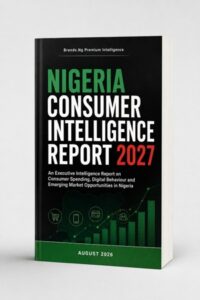
That is why Brands.Ng is building a trust index that goes beyond reputation and brand value. The goal is to measure the companies Nigerians actually rely on through the evidence that matters: consumer complaints, app-store sentiment, regulatory records, pricing transparency, and recent operational history. Brands.Ng Intelligence is designed as an independent research function, publishing objective analysis of publicly available data and verified sources.
For consumers, that means a clearer way to decide where to keep money, where to transact, and which brands deserve caution. For companies, it means a more honest mirror than marketing alone can provide. And for the market as a whole, it means trust can finally be discussed with the seriousness it already deserves.
What is the business outlook for Nigeria in 2026?
The business outlook for Nigeria in 2026 is cautiously improving, but uneven. The country is not in a broad-based boom, and it is not in a collapse either. It is in a transition phase where some sectors are benefiting from reforms, digital adoption, and consumer adaptation, while others remain under pressure from inflation, weak purchasing power, high operating costs, and policy uncertainty.
The clearest sign of that mixed environment is the NESG Business Confidence Monitor. The index improved to 104.6 points in May 2026 from 102.1 in April, yet it still lagged the 109.8 recorded in May 2025. That means the economy is recovering from a lower base rather than entering a clean expansion cycle. The report also says that business activity in May was constrained by limited access to finance, incessant power outages, elevated rental costs, and persistent insecurity, which are not small issues but direct threats to margins and expansion plans.
That is why the outlook is strongest for companies with one or more of the following advantages:
- They sell essential goods or services that consumers cannot easily postpone.
- They have strong digital distribution and low marginal delivery costs.
- They can pass through pricing pressure without destroying demand.
Banks, telecoms, consumer staples, selected payments businesses, and some infrastructure-linked firms fit this profile better than discretionary consumer businesses. Businesses that depend heavily on weak consumer sentiment or nonessential spending remain more exposed to volatility.
There is also a second layer to the outlook: formalization. Nigeria continues to reward businesses that can operate inside structured systems, because formal channels are where trust, credit, and scale increasingly live. Companies with transparent pricing, strong compliance, and visible customer support are likely to outperform peers that still treat disclosure as optional.
So the answer is not simply positive or negative. The business outlook in 2026 is one of selective opportunity. The best companies can still grow strongly, but they must be disciplined, digitally reliable, and trusted.
Which business brings money faster in Nigeria?
The businesses that bring money fastest in Nigeria are usually the ones with rapid turnover, low startup friction, and immediate customer pain points. In practical terms, this usually means trading, food, transport, digital services, and certain forms of agency or brokerage work. These businesses generate cash quickly because customers pay upfront or within short cycles, and because the need they solve is frequent rather than occasional.
Among the fastest-cash businesses are:
- Food sales and quick-service food delivery.
- Transportation and logistics coordination.
- Phone accessories and fast-moving consumer goods trading.
- Event services and rentals.
- Digital agency services, social media management, and content production.
- Short-cycle buying and reselling.
- Agency banking and payment services in the right location.
- Skilled services such as repairs, cleaning, and beauty services.
What makes these businesses fast is not just demand. It is repetition. A business that sells food, processes payments, repairs phones, or moves goods can generate money daily because customers return frequently and the service cycle is short. That is very different from long-cycle businesses like manufacturing, real estate development, or heavy construction, where cash may arrive much later.
But fast money should not be confused with easy money. In Nigeria, many fast-turnover businesses have thin margins. A trader can generate cash quickly but still struggle with stock losses, transport cost, electricity, spoilage, and theft. A logistics or transport business can earn daily but face high fuel and maintenance expenses. A digital service business can scale quickly but may require strong credibility, consistency, and customer acquisition.
If the question is which business is fastest to start making money in, the answer is usually:
- Buying and reselling products with known demand.
- Food and beverage sales.
- Services people need immediately, such as repairs, transport coordination, and errands.
- Digital service offerings that leverage existing skills.
- Payment and agency services in a high-footfall area.
If the question is which business can scale fastest while still making money, digital businesses and structured service businesses often perform best. They do not always produce the first cash as quickly as retail trading, but they can become more profitable and more resilient over time.
What is the future for Nigeria?
Nigeria’s future is best understood as the future of a large, young, resource-rich country that is still trying to convert scale into broad prosperity. The country has several structural advantages that remain intact: a huge domestic market, a young population, entrepreneurial energy, a vibrant private sector, and deep regional influence. Those strengths have not disappeared. What changes in 2026 and beyond is how they get converted into value.
The future is likely to be shaped by five forces:
1. Digitalization.
Nigeria is becoming more digitally organized whether or not every institution is ready for it. Payments, commerce, identity, lending, logistics, and media are increasingly software-mediated. That means firms that can build trusted digital systems will have an advantage.
2. Formalization.
As more business activity moves into recorded channels, informal advantage becomes less durable. Companies with clear records, licences, filings, and compliance structures will attract more institutional money.
3. Consumer skepticism.
Nigerians are becoming more selective. They are less likely to stay loyal out of habit and more likely to switch when experience disappoints them. That makes service quality a major competitive frontier.
4. Demographic pressure.
A young population can be a strength or a burden. If jobs, training, and enterprise opportunities expand, the country benefits. If they do not, unemployment and underemployment become drag forces.
5. Institutional credibility.
The future will depend heavily on whether public institutions and large private institutions can deliver predictability. Investors and consumers both prefer systems that reduce surprise.
So Nigeria’s future is not a single story of decline or breakthrough. It is a contest between scale and friction. The country has enough scale to create significant wealth, but it must reduce friction in power, logistics, policy consistency, and trust.
The companies and sectors that will define the future are the ones that solve real daily problems efficiently. That includes payments, telecoms, logistics, food supply, housing, healthcare access, education, and energy. Nigeria’s future is therefore not just about oil or banks. It is about infrastructure, trust, and execution.
Is Nigeria becoming wealthier?
Nigeria is becoming wealthier in some ways, but not uniformly, and not in a way that every household can immediately feel. The country has seen the growth of large corporate brands, digital businesses, and high-value sectors, and that does indicate wealth creation at the top of the economy. Brand Finance’s 2026 findings show that Nigeria’s leading brands remain highly valuable, and that corporate brand strength is still real even in a difficult environment.
But there is an important distinction between national wealth and broad prosperity. Nigeria can have rising corporate valuations, expanding digital transaction volumes, and stronger brand equity while many households still feel pressure from inflation, weak real incomes, and high living costs. In other words, wealth can be growing at the system level while remaining unevenly distributed at the consumer level.
The best way to think about Nigeria’s wealth trajectory is this:
- The country is creating more formal, measurable economic value than before in some sectors.
- Digital infrastructure is making wealth easier to track and move.
- A growing number of Nigerian companies are becoming more sophisticated and more competitive.
- But household purchasing power remains constrained, which limits how widely wealth is felt.
That means Nigeria is not becoming richer in a simple sense. It is becoming more economically complex. Some firms, investors, founders, and professional households are clearly accumulating more value. But the average consumer still experiences that growth through price pressure, selective opportunity, and uneven access to quality services.
The long-term answer depends on whether growth becomes more inclusive. If Nigeria continues to expand digital commerce, improve infrastructure, deepen finance, and support productive business, then more people will feel the wealth. If not, the economy may continue producing islands of prosperity without enough broad-based lift.
The real answer in one line
Nigeria in 2026 is not a market of easy wins. It is a market where trust, speed, and operational discipline decide who grows, who survives, and who quietly loses relevance.
Stay ahead of the businesses shaping Nigeria.
Get important company developments, analysis, research and business intelligence from Brands.Ng directly on WhatsApp.